Price equation examples
From Wikipedia, the free encyclopedia
In the theory of evolution and natural selection, the Price equation expresses certain relationships between a number of statistical measures on parent and child populations. Without training in the understanding of these measures, the meaning of Price equation is rather opaque. For the less experienced person, simple and particular examples are vital to gaining an intuitive understanding of these statistical measures as they apply to populations, and the relationship between them as expressed in the Price equation.
As an example of the simple Price equation[1] [2] , consider a model for the evolution of sight. Suppose zi is a real number measuring the visual acuity of an organism. An organism with a higher zi will have better sight than one with a lower value of zi. Let us say that the fitness of such an organism is Wi=zi which means the more sighted it is, the fitter it is, that is, the more children it will produce. Beginning with the following description of a parent population composed of 3 types: (i = 0,1,2) with sightedness values zi = 3,2,1:
i 0 1 2 ni 10 20 30 zi 3 2 1
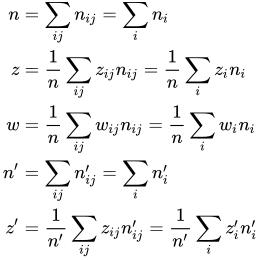
Using Equation (4), the child population (assuming the character zi doesn't change; that is, zi = zi')

i 0 1 2 30 40 30 zi 3 2 1
We would like to know how much average visual acuity has increased or decreased in the population. From Equation (3), the average sightedness of the parent population is z = 5/3. The average sightedness of the child population is z' = 2, so that the change in average sightedness is:
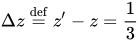
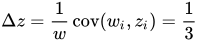
which indicates that the trait of sightedness is increasing in the population. (Note that the covariance formula used below is not the standard covariance formula commonly used in mainstream textbooks. Refer to Equation (2) for Price's definition of covariance in this context.) Applying the Price equation we have (since z′i= zi):
Evolution of sickle cell disease

As an example of dynamical sufficiency, consider the case of sickle cell disease.[3] Each person has two sets of genes, one set inherited from the father, one from the mother. Sickle cell anemia is a blood disorder which occurs when a particular pair of genes both carry the 'sickle-cell trait'. The reason that the sickle-cell gene has not been eliminated from the human population by selection is because when there is only one of the pair of genes carrying the sickle-cell trait, that individual (a "carrier") is highly resistant to malaria, while a person who has neither gene carrying the sickle-cell trait will be susceptible to malaria. Let's see what the Price equation has to say about this.
Let zi=i be the number of sickle-cell genes that organisms of type i have so that zi = 0 or 1 or 2. Assume the population sexually reproduces and matings are random between type 0 and 1, so that the number of 0–1 matings is n0n1/(n0+n1) and the number of i–i matings is n2i/[2(n0+n1)] where i = 0 or 1. Suppose also that each gene has a 1/2 chance of being passed to any given child and that the initial population is ni=[n0,n1,n2]. If b is the birth rate, then after reproduction there will be
- type 0 children (unaffected)
- type 1 children (carriers)
- type 2 children (affected)
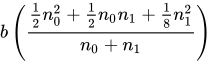
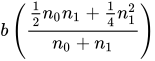
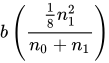
Suppose a fraction a of type 0 reproduce, the loss being due to malaria. Suppose all of type 1 reproduce, since they are resistant to malaria, while none of the type 2 reproduce, since they all have sickle-cell anemia. The fitness coefficients are then:
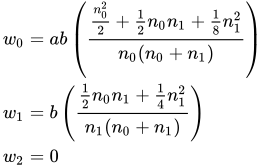
To find the concentration n1 of carriers in the population at equilibrium, with the equilibrium condition of Δ z=0, the simple Price equation is used:

where f=n1/n0. At equilibrium then, assuming f is not zero:
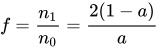
In other words, the ratio of carriers to non-carriers will be equal to the above constant non-zero value. In the absence of malaria, a=1 and f=0 so that the sickle-cell gene is eliminated from the gene pool. For any presence of malaria, a will be smaller than unity and the sickle-cell gene will persist.
The situation has been effectively determined for the infinite (equilibrium) generation. This means that there is dynamical sufficiency with respect to the Price equation, and that there is an equation relating higher moments to lower moments. For example, for the second moments:

The percentage of carriers in a region where malaria is a threat is roughly 10-30% and the percentage of those afflicted with sickle cell disease is roughly 1-2%[4]. At equilibrium, the left and right side of the Price equation are zero. Using , the model predicts the equilibrium concentrations of carriers at 19.1% and the percent of those afflicted as 1.1%. Note that the equilibrium birth rate to maintain a population must be increased above two per mating pair. For , the maintenance birth rate is about 2.24 per mating pair.

Sex ratios
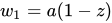
In a 2-sex species or deme with sexes 1 and 2 where , , is the relative frequency of sex 1. Since all individuals have one parent of each sex, the fitness of each sex is proportional to the number of the other sex. Consider proportionality constants and such that and . Under this scenario, a is the number of children a male would have if there he were the only male and unlimited number of females, while b is the number of children a female would have if she were the only female and unlimited number of males. This gives and , so . Hence, so that .





![{\displaystyle cov(w_{i},z_{i})=az(1-z)-(a+b)z^{2}(1-z)=z[1-z][a-(a+b)z]}](https://wikimedia.org/api/rest_v1/media/math/render/svg/201a348386ab93f0148a3d61bbaab6be7f764da3)
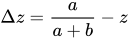

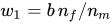
Under another scenario, every woman has a maximum number of children () so that children are created per generation, and every male is responsible for an equal number of children so that where and are the total number of females and males respectively. In this case, the sex ratio stabilizes at .




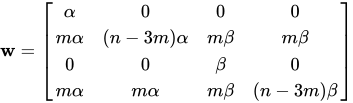
![{\displaystyle z_{i}=\left[0,1,0,1\right]}](https://wikimedia.org/api/rest_v1/media/math/render/svg/4846b0def79f8fdd9e750e785ce5dcbc1d75a19d)
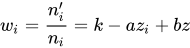


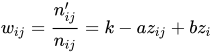
![{\displaystyle {\begin{aligned}n_{i}&=\sum _{j}n_{ij}\\z_{i}&={\frac {1}{n_{i}}}\sum _{j}z_{ij}n_{ij}\\w_{i}&={\frac {1}{n_{i}}}\sum _{j}w_{ij}n_{ij}=k+(b-a)z_{i}\\n_{i}'&=\sum _{j}n_{ij}'=n_{i}[k+(b-a)z_{i}]\\z_{i}'&={\frac {1}{n_{i}'}}\sum _{j}z_{ij}n_{ij}'\end{aligned}}}](https://wikimedia.org/api/rest_v1/media/math/render/svg/684077360830b74f7454d047540b9d3626880d60)