In mathematics, probabilistic metric spaces are a generalization of metric spaces where the distance no longer takes values in the non-negative real numbersR≥0, but in distribution functions.[1]
Then given a non-empty set S and a function F: S × S → D+ where we denote F(p,q) by Fp,q for every (p,q) ∈ S × S, the ordered pair (S,F) is said to be a probabilistic metric space if:
For all u and v in S, u = v if and only if Fu,v(x) = 1 for all x > 0.
For all u and v in S, Fu,v = Fv,u.
For all u, v and w in S, Fu,v(x) = 1 and Fv,w(y) = 1 ⇒ Fu,w(x + y) = 1 for x, y > 0.[2]
Probabilistic metric spaces are initially introduced by Menger, which were termed statistical metrics.[3] Shortly after, Wald criticized the generalized triangle inequality and proposed an alternative one.[4] However, both authors had come to the conclusion that in some respects the Wald inequality was too stringent a requirement to impose on all probability metric spaces, which is partly included in the work of Schweizer and Sklar.[5] Later, the probabilistic metric spaces found to be very suitable to be used with fuzzy sets[6] and further called fuzzy metric spaces[7]
Probability metric of random variables
A probability metric D between two random variablesX and Y may be defined, for example, as
where F(x, y) denotes the joint probability density function of the random variables X and Y. If X and Y are independent from each other, then the equation above transforms into
where f(x) and g(y) are probability density functions of X and Y respectively.
One may easily show that such probability metrics do not satisfy the first metric axiom or satisfies it if, and only if, both of arguments X and Y are certain events described by Dirac delta density probability distribution functions. In this case:
the probability metric simply transforms into the metric between expected values, of the variables X and Y.
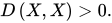
For all other random variablesX, Y the probability metric does not satisfy the identity of indiscernibles condition required to be satisfied by the metric of the metric space, that is:
Probability metric between two random variables X and Y, both having normal distributions and the same standard deviation (beginning with the bottom curve).
denotes a distance between means of X and Y.
The probability metric of random variables may be extended into metric D(X, Y) of random vectorsX, Y by substituting with any metric operator d(x, y):
where F(X, Y) is the joint probability density function of random vectors X and Y. For example substituting d(x, y) with Euclidean metric and providing the vectors X and Y are mutually independent would yield to:
↑Schweizer, Berthold; Sklar, Abe (1983). Probabilistic metric spaces. North-Holland series in probability and applied mathematics. New York: North-Holland. ISBN978-0-444-00666-0.