In propositional logic a resolution proof of a clause  from a set of clauses C is a directed acyclic graph (DAG): the input nodes are axiom inferences (without premises) whose conclusions are elements of C, the resolvent nodes are resolution inferences, and the proof has a node with conclusion .[1]
The DAG contains an edge from a node  to a node
  if and only if a premise of is the conclusion of . In this case, is a child of , and is a parent of . A node with no children is a root.
A proof compression algorithm will try to create a new DAG with fewer nodes that represents a valid proof of or, in some cases, a valid proof of a subset of .
Let's take a resolution proof for the clause  from the set of clauses

Here we can see:
- and are input nodes.
- The node
 has a pivot
  ,
,
- left resolved literal
- right resolved literal

- conclusion is the clause
- premises are the conclusion of nodes and (its parents)
- The DAG would be
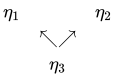
- and are parents of
- is a child of and
- is a root of the proof
A (resolution) refutation of C is a resolution proof of  from C. It is a common given a node
  , to refer to the clause or ’s clause meaning the conclusion clause of , and (sub)proof meaning the (sub)proof having as its only root.
In some works can be found an algebraic representation of resolution inferences. The resolvent of  and
and  with pivot can be denoted as
  . When the pivot is uniquely defined or irrelevant, we omit it and write simply
  . In this way, the set of clauses can be seen as an algebra with a commutative operator; and terms in the corresponding term algebra denote resolution proofs in a notation style that is more compact and more convenient for describing resolution proofs than the usual graph notation.
In our last example the notation of the DAG would be  or simply
We can identify 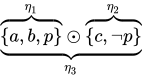 .
.