Prostanthera calycina
From Wikipedia, the free encyclopedia
| West coast mintbush | |
|---|---|
 | |
| In Maranoa Gardens | |
Scientific classification  | |
| Kingdom: | Plantae |
| Clade: | Tracheophytes |
| Clade: | Angiosperms |
| Clade: | Eudicots |
| Clade: | Asterids |
| Order: | Lamiales |
| Family: | Lamiaceae |
| Genus: | Prostanthera |
| Species: | P. calycina |
| Binomial name | |
| Prostanthera calycina | |
 | |
| Occurrence data from AVH | |
| Synonyms[1] | |
| |
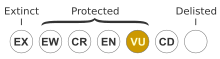
Prostanthera calycina, the West Coast mintbush, limestone mintbush or red mintbush,[2] is a species of flowering plant that is endemic to the Eyre Peninsula in South Australia. It is a small, more or less prostrate shrub with aromatic, elliptic to oblong leaves and red flowers.
Prostanthera calycina is a more or less prostrate shrub that typically grows to a height of about 0.5 m (1 ft 8 in) and has more or less cylindrical, hairy branches. The leaves are well-spaced along the branchlets, elliptic to oblong, 4–14 mm (0.16–0.55 in) long and 3–5 mm (0.12–0.20 in) wide on a densely hairy petiole 0.8–1.4 mm (0.031–0.055 in) long. The leaves are strongly aromatic when crushed. The flowers are arranged singly in leaf axils on a hairy pedicel 2.5–4.5 mm (0.098–0.177 in) long. The sepals are 8–14 mm (0.31–0.55 in) long forming a tube 6–8 mm (0.24–0.31 in) long with two lobes 4–6 mm (0.16–0.24 in) long and 5–7 mm (0.20–0.28 in) wide. The petals are 17.5–22 mm (0.69–0.87 in) long forming a tube 13–15 mm (0.51–0.59 in) long with two lips. The middle lobe on the lower lip is about 4 mm (0.16 in) long and 3 mm (0.12 in) wide, the side lobes about 3 mm (0.12 in) long. The upper lip has two lobes about 5 mm (0.20 in) long and joined but with a small notch between them. Flowering occurs between September and December.[3][4][5]
Taxonomy
Prostanthera calycina was first formally described in 1870 by George Bentham from an unpublished description by Ferdinand von Mueller and the description was published in Flora Australiensis.[6][7]