Prostanthera cineolifera
From Wikipedia, the free encyclopedia
| Singleton mint bush | |
|---|---|
 | |
Scientific classification  | |
| Kingdom: | Plantae |
| Clade: | Tracheophytes |
| Clade: | Angiosperms |
| Clade: | Eudicots |
| Clade: | Asterids |
| Order: | Lamiales |
| Family: | Lamiaceae |
| Genus: | Prostanthera |
| Species: | P. cineolifera |
| Binomial name | |
| Prostanthera cineolifera | |
 | |
| Occurrence data from AVH | |
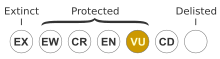
Prostanthera cineolifera, commonly known as the Singleton mint bush,[2] is a species of flowering plant in the family Lamiaceae and is endemic to eastern New South Wales. It is an erect shrub with hairy branches, narrow egg-shaped leaves and clusters of pale mauve to dark purple-mauve flowers arranged on the ends of branchlets.
Prostanthera cineolifera is an erect, strongly aromatic shrub that typically grows to a height of 1–4 m (3 ft 3 in – 13 ft 1 in) with hairy, glandular stems. The leaves are narrow egg-shaped, light green, 12–50 mm (0.47–1.97 in) long and 4–12 mm (0.16–0.47 in) wide on a petiole 2–7 mm (0.079–0.276 in) long. The flowers are arranged in clusters at the ends of the branchlets with bracteoles 1–2 mm (0.039–0.079 in) long that fall off as the flowers develop. The sepals are 3–4 mm (0.12–0.16 in) long and form a tube 2–2.5 mm (0.079–0.098 in) long with two lobes, the upper lobe 1–2 mm (0.039–0.079 in) long. The petals are pale mauve to dark purple-mauve, 8–12 mm (0.31–0.47 in) long, and fused to form a tube that is darker on the inside. Flowering occurs from September to October.[2][3]
Taxonomy
Prostanthera cineolifera was first formally described in 1912 by Richard Thomas Baker and Henry George Smith in Journal and Proceedings of the Royal Society of New South Wales.[4][5]


