Pseudaxine trachuri
From Wikipedia, the free encyclopedia
| Pseudaxine trachuri | |
|---|---|
 | |
| Pseudaxine trachuri, body | |
Scientific classification  | |
| Kingdom: | Animalia |
| Phylum: | Platyhelminthes |
| Class: | Monogenea |
| Order: | Mazocraeidea |
| Family: | Gastrocotylidae |
| Genus: | Pseudaxine |
| Species: | P. trachuri |
| Binomial name | |
| Pseudaxine trachuri Parona & Perugia, 1890[1] | |
| Synonyms | |
| |
Pseudaxine trachuri is a species of monogenean, parasitic on the gills of a marine fish. It belongs to the family Gastrocotylidae.[1][3]
Pseudaxine trachuri was first described and illustrated based on specimens from the gills of the Atlantic horse mackerel Trachurus trachurus (Carangidae) (referred to as Caranx trachurus in the original description) off Genova, Italy. Pseudaxine trachuri was designated the type species of the genus.[1]
Morphology
P. trachuri has the general morphology of all species of Pseudaxine, with a triangular body and an anterior extremity constricted at the level of buccal suckers in some species. The body comprises an anterior part which contains most organs and a posterior part called the haptor. The haptor is oblique and unilateral, and bears numerous clamps arranged in a single row. The clamps of the haptor attach the animal to the gill of the fish. The terminal lappet is present and bears two pairs of anchors. Also, two buccal suckers occur at the anterior extremity. The digestive organs include an anterior, terminal mouth, a pharynx, an oesophagus, and a posterior intestine with two lateral branches provided with numerous secondary branches. Each adult contains male and female reproductive organs. The reproductive organs include an anterior genital atrium, a penis with a corona of hooks, a single ovary, and a number of testes, which are posterior to the ovary.[1][3]
Sequences of the species' 28S rDNA gene and cox1 gene have been published.[4][5][3]
Asymmetry and attachment to the fish's gills
The haptor of P. trachuri may be on the right or on the left. The direction of asymmetry has been shown to depend upon the site of attachment on the host. In fact, the asymmetry of P. trachuri fulfills an important function, which is to bring the longitudinal axis of the body parallel to the gill-ventilating current. Llewellyn studied the adhesive attitude of P. trachuri and revealed that it attaches near to the distal ends of primary lamellae. In P. trachuri, the longitudinal axis of the body is inclined to the adhesive organs at an angle that varies between 30 and 50°. The adhesive organs are applied near the outer lateral borders of the narrow primary lamellae, and the body of the monogenean crosses the inner border of the lamellae. It bends through a right angle and the greater part of the body ends up between two hemibranchs. Sometimes, it bends through 180° so the body of P. trachuri comes in contact with the opposite side of the same lamellae to which its haptor is attached.[6]
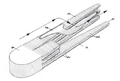 Drawing showing the adhesive attitude of Axine belones, a monogenean with an attachment mode similar to that of Pseudaxine trachuri
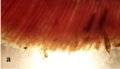 Pseudaxine trachuri attached to gill filaments of the Atlantic horse mackerel Trachurus trachurus, captured off Morocco, North Atlantic
_(Kearn_2004_reproduced_from_Llewellyn).png)
_attached_to_the_gill_(Shawket_et_al_2018).png)
Haptoral innervations
The haptoral innervations of P. trachuri is asymmetrical. The clamps are innervated from the main haptoral nerve. Among the Gastrocotylidae, P. trachuri is unique by the asymmetrical positions of the prehaptoral ganglia. The clamp-side prehaptoral ganglion is situated close to the anteriormost clamps, while the nonclamp side prehaptoral ganglion is situated near the terminal lappet. After the fusion of the main nerve trunks of the nonclamp side, some prominent nerves arise to innervate the lappet. The innervation is different from that of Gastrocotyle trachuri. This is probably due to the attitude of clamps formation of P. trachuri, that occur in a posteroanterior direction, thus, the “prehaptoral” ganglion moves more anteriorly, close to the anteriormost clamps.[7]
Gallery of images
P. trachuri, different body parts
 Drawings of body
 Drawings of male copulatory organ
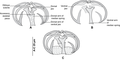 Drawings of clamps
 Buccal suckers
 Ovary
Ovary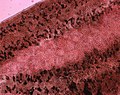 Testes
 Clamps
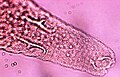 Terminal lappet
 'The pigment in the monogenean's body is haematin derived from ingested fish blood
 Body with black pigment


_Buccal_suckers_(Bouguerche,_Gey,_Tazerouti_&_Justine).jpg)
_Ovary_(Bouguerche,_Gey,_Tazerouti_&_Justine).jpg)
_Testes_(Bouguerche,_Gey,_Tazerouti_&_Justine).jpg)
_Clamps_(Shawket_et_al_2018).png)
_Terminal_lappet_(Bouguerche,_Gey,_Tazerouti_&_Justine).jpg)
_Body_(Kearn_2014).png)
_body_(Shawket_et_al_2018).png)


.jpg)


