Pseudo-determinant
From Wikipedia, the free encyclopedia
In linear algebra and statistics, the pseudo-determinant[1] is the product of all non-zero eigenvalues of a square matrix. It coincides with the regular determinant when the matrix is non-singular.
The pseudo-determinant of a square n-by-n matrix A may be defined as:
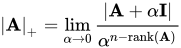
where |A| denotes the usual determinant, I denotes the identity matrix and rank(A) denotes the matrix rank of A.[2]
Definition of pseudo-determinant using Vahlen matrix
The Vahlen matrix of a conformal transformation, the Möbius transformation (i.e. for ), is defined as . By the pseudo-determinant of the Vahlen matrix for the conformal transformation, we mean


![{\displaystyle [f]={\begin{bmatrix}a&b\\c&d\end{bmatrix}}}](https://wikimedia.org/api/rest_v1/media/math/render/svg/beb4225f3f146016b696fe2bcc46d367dd05dfa2)
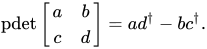
If , the transformation is sense-preserving (rotation) whereas if the , the transformation is sense-preserving (reflection).
![{\displaystyle \operatorname {pdet} [f]>0}](https://wikimedia.org/api/rest_v1/media/math/render/svg/ec20949e08d99803f550b87ff417ada06650e52a)
![{\displaystyle \operatorname {pdet} [f]<0}](https://wikimedia.org/api/rest_v1/media/math/render/svg/50407b4b440628903868e889a6413aa5fdd45caa)
Computation for positive semi-definite case
If is positive semi-definite, then the singular values and eigenvalues of coincide. In this case, if the singular value decomposition (SVD) is available, then may be computed as the product of the non-zero singular values. If all singular values are zero, then the pseudo-determinant is 1.


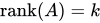
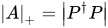
Supposing , so that k is the number of non-zero singular values, we may write where is some n-by-k matrix and the dagger is the conjugate transpose. The singular values of are the squares of the singular values of and thus we have , where is the usual determinant in k dimensions. Further, if is written as the block column , then it holds, for any heights of the blocks and , that .