Pseudopterosin A
From Wikipedia, the free encyclopedia
 | |
| Names | |
|---|---|
| IUPAC name
(3S,7R,9S,9aR)-5-Hydroxy-3,6,9-trimethyl-7-(2-methylprop-1-en-1-yl)-2,3,7,8,9,9a-hexahydro-1H-phenalen-4-yl β-D-xylopyranoside | |
| Systematic IUPAC name
(2S,3R,4S,5R)-2-{[(3S,7R,9S,9aR)-5-Hydroxy-3,6,9-trimethyl-7-(2-methylprop-1-en-1-yl)-2,3,7,8,9,9a-hexahydro-1H-phenalen-4-yl]oxy}oxane-3,4,5-triol | |
| Identifiers | |
3D model (JSmol) |
|
| ChEMBL | |
| ChemSpider | |
PubChem CID |
|
| UNII | |
CompTox Dashboard (EPA) |
|
| |
| |
| Properties | |
| C25H36O6 | |
| Molar mass | 432.557 g·mol−1 |
Except where otherwise noted, data are given for materials in their standard state (at 25 °C [77 °F], 100 kPa).
| |


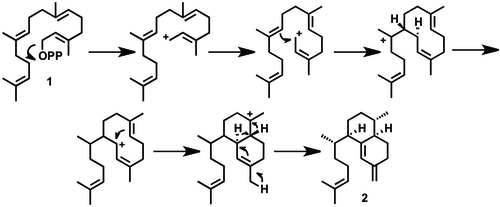
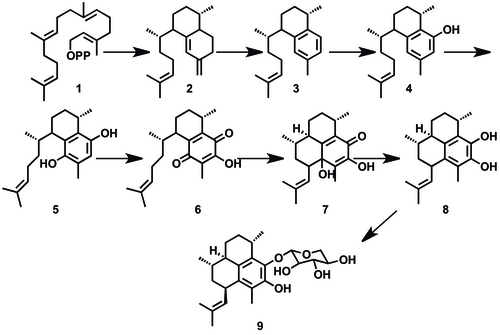
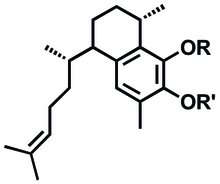
Pseudopterosin A is a diterpene glycoside isolated from the gorgonian sea whip Antillogorgia elisabethae, found in the Bahamas and Florida Keys.[1] Pseudopterosins A-D, which differ in the degree of acetylation at the sugar ring, were first isolated and reported in 1986.[2] There are at least 25 unique diterpenes isolated from this species of marine animal.[1] Samples of P. elisabethae from the Bahamas are found to have higher concentrations of pseudopterosins than populations from the Florida Keys, which have a greater diversity in diterpene structures.[3]