Q-category
From Wikipedia, the free encyclopedia
In mathematics, a Q-category or almost quotient category[1] is a category that is a "milder version of a Grothendieck site."[2] A Q-category is a coreflective subcategory.[1][clarification needed] The Q stands for a quotient.
The concept of Q-categories was introduced by Alexander Rosenberg in 1988.[2] The motivation for the notion was its use in noncommutative algebraic geometry; in this formalism, noncommutative spaces are defined as sheaves on Q-categories.
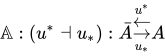
A Q-category is defined by the formula[1][further explanation needed] where is the left adjoint in a pair of adjoint functors and is a full and faithful functor.