Q-exponential
From Wikipedia, the free encyclopedia
The term q-exponential occurs in two contexts. The q-exponential distribution, based on the Tsallis q-exponential is discussed in elsewhere.
In combinatorial mathematics, a q-exponential is a q-analog of the exponential function, namely the eigenfunction of a q-derivative. There are many q-derivatives, for example, the classical q-derivative, the Askey–Wilson operator, etc. Therefore, unlike the classical exponentials, q-exponentials are not unique. For example, is the q-exponential corresponding to the classical q-derivative while are eigenfunctions of the Askey–Wilson operators.


The q-exponential is also known as the quantum dilogarithm.[1][2]
The q-exponential is defined as
![{\displaystyle e_{q}(z)=\sum _{n=0}^{\infty }{\frac {z^{n}}{[n]!_{q}}}=\sum _{n=0}^{\infty }{\frac {z^{n}(1-q)^{n}}{(q;q)_{n}}}=\sum _{n=0}^{\infty }z^{n}{\frac {(1-q)^{n}}{(1-q^{n})(1-q^{n-1})\cdots (1-q)}}}](https://wikimedia.org/api/rest_v1/media/math/render/svg/1df0494e3aee34b37279c904f912f2d4f81dc311)
where is the q-factorial and
![{\displaystyle [n]!_{q}}](https://wikimedia.org/api/rest_v1/media/math/render/svg/b9908fef01f897a1326dac11c8c37a95c82e2c5f)

is the q-Pochhammer symbol. That this is the q-analog of the exponential follows from the property
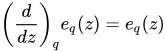
where the derivative on the left is the q-derivative. The above is easily verified by considering the q-derivative of the monomial
![{\displaystyle \left({\frac {d}{dz}}\right)_{q}z^{n}=z^{n-1}{\frac {1-q^{n}}{1-q}}=[n]_{q}z^{n-1}.}](https://wikimedia.org/api/rest_v1/media/math/render/svg/c5454c7904c36ab46a23fd93c086675aa4f7f618)
Here, is the q-bracket. For other definitions of the q-exponential function, see Exton (1983), Ismail & Zhang (1994), and Cieśliński (2011).
![{\displaystyle [n]_{q}}](https://wikimedia.org/api/rest_v1/media/math/render/svg/3dfd22063139d4a06ae9dfcaf79a85a2b2f751fc)













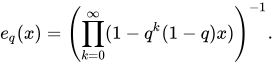
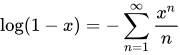

![{\displaystyle {\begin{aligned}\log e_{q}(x)&=-\sum _{k=0}^{\infty }\log(1-q^{k}(1-q)x)\\&=\sum _{k=0}^{\infty }\sum _{n=1}^{\infty }{\frac {(q^{k}(1-q)x)^{n}}{n}}\\&=\sum _{n=1}^{\infty }{\frac {((1-q)x)^{n}}{(1-q^{n})n}}\\&={\frac {1}{1-q}}\sum _{n=1}^{\infty }{\frac {((1-q)x)^{n}}{[n]_{q}n}}\end{aligned}}.}](https://wikimedia.org/api/rest_v1/media/math/render/svg/adeebd93d418e5c68eada4e8607dcf515f21a37f)


