Qavam House
Historic site in Shiraz, Iran
From Wikipedia, the free encyclopedia
Qavam House (Persian: خانه قوام), also known as Narenjestan-e Qavam (Persian: نارنجستان قوام),[1][2] is a Qajar era house and garden in Shiraz, Iran, built between 1879 and 1886.

Alternative namesNarenjestan-e Ghavam, Ghavam House, Qavam Pavilion, House of Ghavam
Architectural styleQajar style
LocationLotf Ali Khan Zand St, Shiraz, Fars province, Iran
| Qavam House | |
|---|---|
Front facade with the image of the "Lion and Sun" (Qajar royal emblem) on the pediment. | |
 Interactive map of the Qavam House area | |
| Alternative names | Narenjestan-e Ghavam, Ghavam House, Qavam Pavilion, House of Ghavam |
| General information | |
| Architectural style | Qajar style |
| Location | Lotf Ali Khan Zand St, Shiraz, Fars province, Iran |
| Coordinates | 29°36′28.24″N 52°33′9.25″E |
During the reign of Mohammad Reza Pahlavi, the house became the headquarters of Pahlavi University's Asia Institute, directed by Arthur Upham Pope,[1][3] and later Richard Nelson Frye. The house and gardens are now a museum and open to the public.
Architecture
The house was built between 1879 and 1886[4] by Mirza Ibrahim Khan. The building stands two meters above the garden and is mainly made of bricks.
The Narenjestan garden is an example of the Persian gardens of Iran.
Gallery
 Interior of the house
 Interior of the house
 Interior of the house
 Wall painting depicting three Qajar figures.
 View from the garden
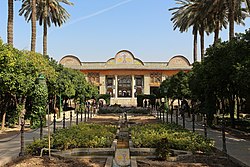 Garden and the building in Spring.
 View of the garden from the house.
 Pool and stone facade.


.jpg)


