Qiandeng
Town in Jiangsu, People's Republic of China
From Wikipedia, the free encyclopedia
Qiandeng (simplified Chinese: 千灯; traditional Chinese: 千燈; pinyin: Qiāndēng; lit. 'one thousand lamps') is a town in Kunshan, Suzhou, Jiangsu, China.[1] As of 2018[update], it has 12 residential communities and 16 villages under its administration.[2] It is located 15 kilometres (9.3 mi) south of Kunshan city and borders Qingpu District, Shanghai on its east side. Qiandeng has an area of 84 km2 and a population of about 130,000.

Qiandeng
千灯镇 | |
|---|---|
| |
  Qiandeng Location in Jiangsu  Qiandeng Qiandeng (China) | |
| Coordinates: 31°15′27″N 121°01′13″E | |
| Country | People's Republic of China |
| Province | Jiangsu |
| Prefecture-level city | Suzhou |
| County-level city | Kunshan |
| Time zone | UTC+8 (China Standard) |
| Qiandeng | |||||||||
|---|---|---|---|---|---|---|---|---|---|
| Simplified Chinese | 千灯 | ||||||||
| Traditional Chinese | 千燈 | ||||||||
| Literal meaning | one thousand lamps | ||||||||
| |||||||||
Qiandeng has a rich cultural heritage. It was the native place of Gu Jian, the founder of Kunqu. It was also the birthplace of the famous Ming dynasty writer Gu Yanwu. Qiandeng is now a national historical and cultural town in China, as well as a national 4A grade scenic destination.
History
Qiandeng was called Qiandun (Chinese: 千墩; lit. 'one thousand piers') since the Ming dynasty. It was renamed Qiandun village in 1910, established as a township in 1950, and changed to its present name in 2003.
 4A travel destination
 Ancient slabstone lane
 Peony pavilion


Gu Jian Museum


Former residence of Gu Yanwu
The former residence of Gu Yanwu was built by Gu Yanwu's grandfather, it was destroyed by Japanese pirates, later rebuilt. It is a Ming Dynasty style building complex with formal sitting room, dining room, study and a garden. Gu Yanwu's grave is located at a quiet corner of the Gu Garden
 Former residence of Gu Yanwu
 Parlor Yi An Hall
 Study
Study Gu Garden
 Grave of Gu Yanwu


Thousand Lamp Museum
A unique exhibition with the town's namesake is Qiandeng Guan (Thousand Lamp Museum), with more than one thousand lamps, dated as early as Neolithic Age to modern times, spanning more than five thousand years.
 Thousand Lamp Museum
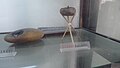 Qiandeng Museum Neolithic stone lamp
 Han Dynasty Pottery lamp feathering a mother holding several babies
 Tang Dynasty lamp from the Western Region
 Yuan Dynasty lamp
 Ming Dynasty bronze lamp


_The_Art_Sculpture_of_Harmony.jpg)