Quadratic Gauss sum
From Wikipedia, the free encyclopedia
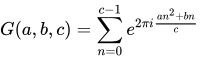
In number theory, quadratic Gauss sums are certain finite sums of roots of unity. A quadratic Gauss sum can be interpreted as a linear combination of the values of the complex exponential function with coefficients given by a quadratic character; for a general character, one obtains a more general Gauss sum. These objects are named after Carl Friedrich Gauss, who studied them extensively and applied them to quadratic, cubic, and biquadratic reciprocity laws.
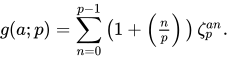
For an odd prime number p and an integer a, the quadratic Gauss sum g(a; p) is defined as

where is a primitive pth root of unity, for example . Equivalently, we can write this using the Legendre symbol as


For a divisible by p, and we have and thus


For a not divisible by p, we have , implying that

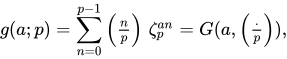
where
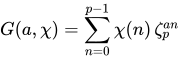
is the Gauss sum defined for any character χ modulo p.
Properties
- The value of the Gauss sum is an algebraic integer in the pth cyclotomic field .
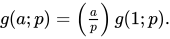
- The evaluation of the Gauss sum for an integer a not divisible by a prime p > 2 can be reduced to the case a = 1:

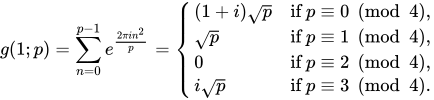
- The exact value of the Gauss sum for a = 1 is given by the formula:[1]
- Remark
In fact, the identity
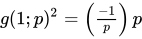
was easy to prove and led to one of Gauss's proofs of quadratic reciprocity. However, the determination of the sign of the Gauss sum turned out to be considerably more difficult: Gauss could only establish it after several years' work. Later, Dirichlet, Kronecker, Schur and other mathematicians found different proofs.