Quantum clock model
From Wikipedia, the free encyclopedia
The quantum clock model is a quantum lattice model.[1] It is a generalisation of the transverse-field Ising model . It is defined on a lattice with states on each site. The Hamiltonian of this model is


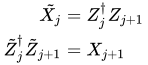
Here, the subscripts refer to lattice sites, and the sum is done over pairs of nearest neighbour sites and . The clock matrices and are generalisations of the Pauli matrices satisfying


- and
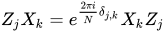
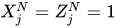
where is 1 if and are the same site and zero otherwise. is a prefactor with dimensions of energy, and is another coupling coefficient that determines the relative strength of the external field compared to the nearest neighbor interaction.


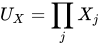
The model obeys a global symmetry, which is generated by the unitary operator where the product is over every site of the lattice. In other words, commutes with the Hamiltonian.


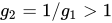
When the quantum clock model is identical to the transverse-field Ising model. When the quantum clock model is equivalent to the quantum three-state Potts model. When , the model is again equivalent to the Ising model. When , strong evidences have been found that the phase transitions exhibited in these models should be certain generalizations [2] of Kosterlitz–Thouless transition, whose physical nature is still largely unknown.