Quantum inequalities
From Wikipedia, the free encyclopedia
Quantum inequalities[1] are local constraints on the magnitude and extent of distributions of negative energy density in space-time. Initially conceived to clear up a long-standing problem in quantum field theory (namely, the potential for unconstrained negative energy density at a point), quantum inequalities have proven to have a diverse range of applications.[2]
The form of the quantum inequalities is reminiscent of the uncertainty principle.
Einstein's theory of General Relativity amounts to a description of the relationship between the curvature of space-time, on the one hand, and the distribution of matter throughout space-time on the other. This precise details of this relationship are determined by the Einstein equations
.

Here, the Einstein tensor describes the curvature of space-time, whilst the energy–momentum tensor describes the local distribution of matter. ( is a constant.) The Einstein equations express local relationships between the quantities involved—specifically, this is a system of coupled non-linear second order partial differential equations.


A very simple observation can be made at this point: the zero-point of energy-momentum is not arbitrary. Adding a "constant" to the right-hand side of the Einstein equations will effect a change in the Einstein tensor, and thus also in the curvature properties of space-time.
All known classical matter fields obey certain "energy conditions". The most famous classical energy condition is the "weak energy condition"; this asserts that the local energy density, as measured by an observer moving along a time-like world line, is non-negative. The weak energy condition is essential for many of the most important and powerful results of classical relativity theory—in particular, the singularity theorems of Hawking et al. Hawking radiation suggests that black holes emit thermal energy due to quantum effects, even though nothing escapes their event horizon directly. This process aligns with quantum inequalities, which set strict limits on how much energy can appear or disappear in a given space. These inequalities ensure that Hawking radiation remains consistent with the laws of physics, reinforcing the reality of both phenomena and their connection in extreme spacetime conditions.[3] In addition, we have The Penrose inequality which is a rule that says the mass (or energy) of a black hole is related to the size of its event horizon (the boundary beyond which nothing can escape). This idea supports "cosmic censorship," which is the idea that we can never directly see a "naked" singularity (a point of infinite density inside a black hole).
In the quantum world, which deals with very small particles, this rule gets expanded to include something called "entropy." Entropy is a way to measure how disordered or chaotic a system is. The idea is that the total entropy (or disorder) of a system, including both the black hole and the quantum matter around it, should never decrease. This idea helps ensure that the laws of physics stay consistent, even in the strange world of quantum mechanics.[4]
Energy conditions in quantum field theory
The situation in quantum field theory is rather different: the expectation value of the energy density can be negative at any given point. In fact, things are even worse: by tuning the state of the quantum matter field, the expectation value of the local energy density can be made arbitrarily negative.
Inequalities
The general form of worldline Quantum Inequality is the following equation. There are many variations towards quantum inequalities but this where all are derived from.


[6] For free, massless, minimally coupled scalar fields, for all the following inequality holds along any inertial observer worldline with velocity and proper time :[7]


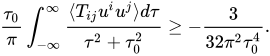
This implies the averaged weak energy condition as , but also places stricter bounds on the length of episodes of negative energy.

Similar bounds can be constructed for massive scalar or electromagnetic fields.[8] Related theorems imply that pulses of negative energy need to be compensated by a larger positive pulse (with magnitude growing with increasing pulse separation).[9]
Note that the inequality above only applies to inertial observers: for accelerated observers weaker or no bounds entail.[10][11]
Applications
Distributions of negative energy density comprise what is often referred to as exotic matter, and allow for several intriguing possibilities: for example, the Alcubierre drive potentially allows for faster-than-light space travel.
Quantum inequalities constrain the magnitude and space-time extent of negative energy densities. In the case of the Alcubierre warp drive mentioned above, the quantum inequalities predict that the amount of exotic matter required to create and sustain the warp drive "bubble" far exceeds the total mass-energy of the universe.