Radical 29
Chinese character radical
From Wikipedia, the free encyclopedia
Radical 29 or radical again (又部) meaning "and", "again" or "right hand" is one of the 23 Kangxi radicals (214 radicals total) composed of two strokes.

| 又 | |
|---|---|
Radical 29 (U+2F1C)
| |
| 又 (U+53C8) "right hand" | |
| Pronunciations | |
| Pinyin: | yòu |
| Bopomofo: | ㄧㄡˋ |
| Gwoyeu Romatzyh: | yow |
| Wade–Giles: | yu4 |
| Cantonese Yale: | yauh |
| Jyutping: | jau6 |
| Pe̍h-ōe-jī: | iū |
| Japanese Kana: | ユウ yū (on'yomi) また mata (kun'yomi) |
| Sino-Korean: | 우 u |
| Names | |
| Chinese name(s): | 又字旁 yòuzìpáng |
| Japanese name(s): | 又/また mata |
| Hangul: | 또 tto |
| Stroke order animation | |
| |
In the Kangxi Dictionary, there are 91 characters (out of 49,030) to be found under this radical.
又 is also the 24th indexing component in the Table of Indexing Chinese Character Components predominantly adopted by Simplified Chinese dictionaries published in mainland China.
Evolution
 Oracle bone script character
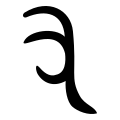 Bronze script character
 Large seal script character
 Small seal script character


The radical character 又's ancient form is a pictogram of a right hand from which the modern Chinese character 右 (right) was derived. Though 又 (again) as a modern Chinese character no longer represents the meaning of "right", the implication of "hand" is preserved in some Chinese characters that fall under radical 29.
Derived characters
Sinogram
As an independent sinogram it is a Jōyō kanji, or a kanji used in writing the Japanese language.[1] It is a secondary school kanji.[2]
