A general expression for the payoff of a range accrual is:
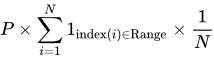
- index(i) is the value of the index at the ith observation date
- N is the total number of observations within a period
- P is the payout when the index is in the range
If the observation frequency is daily, the payoff could be more easily written as

where
- n is the number of days a specified index is within a given range
- N is the total number of days of the observation period
- P is the payout for any given day where the index is in the range
The index could be an interest rate (e.g. USD 3 months Libor), or a FX rate (e.g. EUR/USD) or a commodity (e.g. oil price) or any other observable financial index.
The observation period can be different from daily (e.g. weekly, monthly, etc.), though a daily observation is the most encountered.
The receiver of the range accrual coupons is selling binary options. The value of these options is used to enhance the coupon paid.
Let's take an example of a 5 years range accrual note linked to USD 3 months Libor, with range set as [1.00%; 6.00%] and a conditional coupon of 5.00%. Let's assume the note to start on January 1, 2009 and the first coupon payment to happen on July 1, 2009.
An investor who buys USD 100m of this note will have the following cash flows:
- First coupon — Between January 1 and July 1, 2009, if USD 3m Libor fixes between
1.00% and 6.00% for 130 days, then the rate applied for the first semester will be:
- 5.00% × 130/181 = 3.5912% (there are 181 days in total between January 1, 2009 and July 1, 2009).
- The coupon paid on July 1, 2009 would be: US$100m × 3.5912% × 0.5 = $1,795,600 (assuming 0.5 for the day-count fraction between January 1, 2009 and July 1, 2009)
- Second coupon - Between July 1, 2009 and January 1, 2010, if USD 3m Libor fixes between 1.00% and 6.00% for 155 days, then the rate applied for the second semester will be:
- 5.00% × 155/184= 4.2120%.
- The coupon paid on January 1, 2010 would be: US$100m × 4.2120% × 0.5 = $2,106,000 (assuming 0.5 for the day-count fraction between July 1, 2009 and January 1, 2010).
- For the 8 following coupons, the same methodology applies. The highest rate investor will get is 5.00% and the lowest 0.00%.
The payout (P in our notation), for each day the index is in the range, could be either a fix or variable rate.