Rao Jodha Desert Rock Park
From Wikipedia, the free encyclopedia
| Rao Jodha Desert Rock Park | |
|---|---|
 Mehrangarh Fort above Rao Jodha Desert Rock Park | |
 | |
| Type | Natural Area |
| Location | Jodhpur, Rajasthan |
| Nearest city | Jodhpur |
| Coordinates | 26°18′17″N 73°01′01″E / 26.304611°N 73.016853°E |
| Area | 70 hectares |
| Created | 2006 |
| Operated by | Mehrangarh Museum Trust |
| Visitors | +919571271000 |
| Open | 7:00am-6:30pm (in summer), 8:00am-5:30pm (in winter) |
| Status | Open |
Rao Jodha Desert Rock Park, spreads over 72 hectares, near the historic Mehrangarh Fort in Jodhpur, Rajasthan, India. The park contains ecologically restored desert and arid land vegetation.[1][2] The park was created in 2006 to try and restore the natural ecology of a large, rocky area adjoining and below the fort. It was opened to the public in February 2011. The area in and around the park contains distinctive volcanic rock and sandstone formations. The park includes a Visitors Centre with Interpretation Gallery, a native plant nursery, small shop and cafe. There are four trails (yellow, green, red, and blue trails), about 880 m to 1115 m long, that visitors can take and trained guides and naturalists are also available.
Jodhpur Welded Tuff here has been declared the National Geological Monuments of India by the Geological Survey of India (GSI), for their protection, maintenance, promotion and enhancement of geotourism.[3][4][5] The volcanic rocks at Rao Jodha Desert Rock Park were formed somewhere between 745 and 680 million years ago. The volcanic formations are chiefly rhyolite, with welded tuff, and breccia found in some areas. There is a gully passing through the park (an old aqueduct or canal to carry rainwater from a wider catchment in the north to Padamsar lake at the base of the fort), where breccia is visible today. Also seen are rocks with large to intermediate crystal sizes and from fine textured tuff to large-grained (porphyritic) rhyolite.[6]
Plant and animal life
The park has around 250 species of native plants, including a large number of arid region lithophytes. Some of the common plants[7] include trees such as Rohido (Tecomella undulata), Kumatiyo (Acacia senegal), Hingoto (Balanites roxburghii), Peeloo (Salvadora persica), Kharo Jaal (Salvadora oleoides), Sargooro (Moringa concanensis), Goondi (Cordia sinensis), and Bordi (Ziziphus nummularia). Among shrubs, the leafless spurge or Thhor (Euphorbia caducifolia) is one of the common succulents. Other shrubs include Bui (Aerva javanica), Aakado (Calotropis procera), Kair (Capparis decidua), Ghatbor (Fleuggia leucopyrus), Kheer Kheemp (Sarcostemma acidum), Kheemp (Leptadenia pyrotechnica), and Googal (Commiphora wightii).
 Sarcostemma acidum flowering
 Common banded awl butterfly on Sarcostemma acidum flowers
 Euphorbia caducifolia growing in rocky area
 Euphorbia caducifolia close up
 Red-vented Bulbul on fruiting Fleuggia leucopyrus
 Indian crested porcupine Rao Jodha Jodhpur Rajasthan
 Female Indian Golden Oriole


The park has several reptile species and over 200 species of birds and is an eBird hotspot.[8] Mammals include free-ranging dogs, Indian crested porcupine, and northern or five-striped palm squirrel.
 Plain Tiger butterfly in Rao Jodha Desert Rock Park
 Common Babbler on the rocks
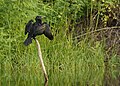 Indian Cormorant at lake in Jaswant Thada
 Great Egret in lake at Jaswant Thada
 Grey Francolin amidst rocks and desert vegetation
 White-eared Bulbul on Fleuggea leucopyrus
 Five-striped or northern palm squirrel in Rao Jodha


