Rational difference equation
From Wikipedia, the free encyclopedia
A rational difference equation is a nonlinear difference equation of the form[1][2][3][4]

where the initial conditions are such that the denominator never vanishes for any n.

First-order rational difference equation
A first-order rational difference equation is a nonlinear difference equation of the form
| 2 |
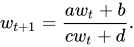
When and the initial condition are real numbers, this difference equation is called a Riccati difference equation.[3]


Such an equation can be solved by writing as a nonlinear transformation of another variable which itself evolves linearly. Then standard methods can be used to solve the linear difference equation in .


Equations of this form arise from the infinite resistor ladder problem.[5][6]
Solving a first-order equation
First approach
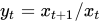
WLoG, the determinant-like quantity , and this can be easily seen by noting that, with a division on both the numerator and denominator in Equation (2), you can always set , in which case, if , then the numerator and denominator will cancel away, leaving no difference equation left, being instead so completely reduced as to become exactly the constant . Thus, one approach[7] to developing the transformed variable , is to write


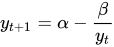
where and and where .
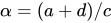

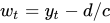
Further writing can be shown to yield

Second approach
The above approach is already of general applicability. This following approach[8] gives a first-order difference equation for instead of a second-order one. Let . For the case in which , every term will be real-valued and this method may be convenient to use. Otherwise, the method still works, but complex numbers will appear, and it might be more convenient to attempt a trigonometric ansatz instead. Substituting , which implies , into Equation (2), we find that it is always possible to make evolve according to the simple inhomogeneous first-order linear difference equation




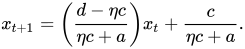
by choosing such that , and it is clear that this can always be done in either of the two choices , even when


Third approach
The equation
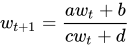
can also be solved by treating it as a special case of the more general matrix equation

where all of A, B, C, E, and X are n × n matrices (in this case n = 1); the solution of this is[9]
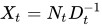
where
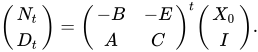
Application
It was shown in [10] that a dynamic matrix Riccati equation of the form

which can arise in some discrete-time optimal control problems, can be solved using the second approach above if the matrix C has only one more row than column.