Rational sieve
From Wikipedia, the free encyclopedia
In mathematics, the rational sieve is a general algorithm for factoring integers into prime factors. It is a special case of the general number field sieve. While it is less efficient than the general algorithm, it is conceptually simpler. It serves as a helpful first step in understanding how the general number field sieve works.
Suppose we are trying to factor the composite number n. We choose a bound B, and identify the factor base (which we will call P), the set of all primes less than or equal to B. Next, we search for positive integers z such that both z and z + n are B-smooth — i.e. all of their prime factors are in P. We can therefore write, for suitable exponents ai and bi,

But z and are congruent modulo n, and so each such integer z that we find yields a multiplicative relation (mod n) among the elements of P, i.e.

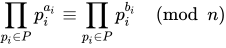
(where the ai and bi are nonnegative integers.)
When we have generated enough of these relations (it is generally sufficient that the number of relations be a few more than the size of P), we can use the methods of linear algebra to multiply together these various relations in such a way that the exponents of the primes are all even. This will give us a congruence of squares of the form a2 ≡ b2 (mod n), which can be turned into a factorization of n = gcd(a + b, n) × gcd(a − b, n). This factorization might turn out to be trivial (i.e. n = n × 1), in which case we have to try again with a different combination of relations, but with luck we will get a nontrivial pair of factors of n, and the algorithm will terminate.
Example
We will factor the integer n = 187 using the rational sieve. We will arbitrarily try the value B = 7, giving the factor base P = {2,3,5,7}. The first step is to test n for divisibility by each of the members of P; clearly if n is divisible by one of these primes, then we are finished already. However, 187 is not divisible by 2, 3, 5, or 7. Next, we search for suitable values of z; the first few are 2, 5, 9, and 56. These four suitable values of z give four multiplicative relations (mod 187):
| 1 |

| 2 |

| 3 |

| 4 |

There are now several essentially different ways to combine these and end up with even exponents. For example,
- (1)×(4): After multiplying these and canceling out the common factor of 7 (which we can do since 7, being a member of P, has already been determined to be coprime with n[1]), this reduces to 24 ≡ 38 (mod n). The resulting factorization is 187 = gcd(34 + 22, 187) × gcd(34 − 22, 187) = 11 × 17.
Alternatively, equation (3) is in the proper form already:
- (3): This says 32 ≡ 142 (mod n), which gives the factorization 187 = gcd(14 + 3, 187) × gcd(14 − 3, 187) = 11 × 17.