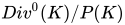
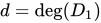
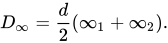
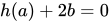
Real hyperelliptic curve
From Wikipedia, the free encyclopedia
In mathematics, there are two types of hyperelliptic curves, a class of algebraic curves: real hyperelliptic curves and imaginary hyperelliptic curves which differ by the number of points at infinity. Hyperelliptic curves exist for every genus . The general formula of hyperelliptic curve over a finite field is given by where satisfy certain conditions. In this page, we describe more about real hyperelliptic curves, these are curves having two points at infinity while imaginary hyperelliptic curves have one point at infinity.


![{\displaystyle C:y^{2}+h(x)y=f(x)\in K[x,y]}](https://wikimedia.org/api/rest_v1/media/math/render/svg/b5056ffe1ad417871c527b9e9d83ff8b00c01fe9)

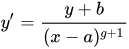
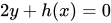
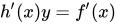
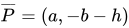
A real hyperelliptic curve of genus g over K is defined by an equation of the form where has degree not larger than g+1 while must have degree 2g+1 or 2g+2. This curve is a non singular curve where no point in the algebraic closure of satisfies the curve equation and both partial derivative equations: and . The set of (finite) –rational points on C is given by where is the set of points at infinity. For real hyperelliptic curves, there are two points at infinity, and . For any point , the opposite point of is given by ; it is the other point with x-coordinate a that also lies on the curve.









Example
Let where over . Since and has degree 6, thus is a curve of genus g = 2.






The homogeneous version of the curve equation is given by It has a single point at infinity given by (0:1:0) but this point is singular. The blowup of has 2 different points at infinity, which we denote and . Hence this curve is an example of a real hyperelliptic curve.

In general, every curve given by an equation where f has even degree has two points at infinity and is a real hyperelliptic curve while those where f has odd degree have only a single point in the blowup over (0:1:0) and are thus imaginary hyperelliptic curves. In both cases this assumes that the affine part of the curve is non-singular (see the conditions on the derivatives above)

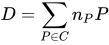



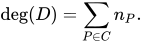













![{\displaystyle G\in K[C]}](https://wikimedia.org/api/rest_v1/media/math/render/svg/4869295e937af86ba63885c38533abe412134a7f)

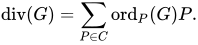


![{\displaystyle K[C]}](https://wikimedia.org/api/rest_v1/media/math/render/svg/63024aa1570aaad7c36deeef879a55e44ac30d24)