Real representation
From Wikipedia, the free encyclopedia
In the mathematical field of representation theory a real representation is usually a representation on a real vector space U, but it can also mean a representation on a complex vector space V with an invariant real structure, i.e., an antilinear equivariant map

which satisfies

The two viewpoints are equivalent because if U is a real vector space acted on by a group G (say), then V = U⊗C is a representation on a complex vector space with an antilinear equivariant map given by complex conjugation. Conversely, if V is such a complex representation, then U can be recovered as the fixed point set of j (the eigenspace with eigenvalue 1).
In physics, where representations are often viewed concretely in terms of matrices, a real representation is one in which the entries of the matrices representing the group elements are real numbers. These matrices can act either on real or complex column vectors.
A real representation on a complex vector space is isomorphic to its complex conjugate representation, but the converse is not true: a representation which is isomorphic to its complex conjugate but which is not real is called a pseudoreal representation. An irreducible pseudoreal representation V is necessarily a quaternionic representation: it admits an invariant quaternionic structure, i.e., an antilinear equivariant map
which satisfies

A direct sum of real and quaternionic representations is neither real nor quaternionic in general.
A representation on a complex vector space can also be isomorphic to the dual representation of its complex conjugate. This happens precisely when the representation admits a nondegenerate invariant sesquilinear form, e.g. a hermitian form. Such representations are sometimes said to be complex or (pseudo-)hermitian.
A criterion (for compact groups G) for reality of irreducible representations in terms of character theory is based on the Frobenius-Schur indicator defined by
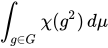
where χ is the character of the representation and μ is the Haar measure with μ(G) = 1. For a finite group, this is given by
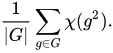
The indicator may take the values 1, 0 or −1. If the indicator is 1, then the representation is real. If the indicator is zero, the representation is complex (hermitian),[1] and if the indicator is −1, the representation is quaternionic.