Reduction (mathematics)
From Wikipedia, the free encyclopedia
In mathematics, reduction refers to the rewriting of an expression into a simpler form. For example, the process of rewriting a fraction into one with the smallest whole-number denominator possible (while keeping the numerator a whole number) is called "reducing a fraction". Rewriting a radical (or "root") expression with the smallest possible whole number under the radical symbol is called "reducing a radical". Minimizing the number of radicals that appear underneath other radicals in an expression is called denesting radicals.
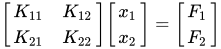
In linear algebra, reduction refers to applying simple rules to a series of equations or matrices to change them into a simpler form. In the case of matrices, the process involves manipulating either the rows or the columns of the matrix and so is usually referred to as row-reduction or column-reduction, respectively. Often the aim of reduction is to transform a matrix into its "row-reduced echelon form" or "row-echelon form"; this is the goal of Gaussian elimination.
Calculus
In calculus, reduction refers to using the technique of integration by parts to evaluate integrals by reducing them to simpler forms.