Relation network
From Wikipedia, the free encyclopedia
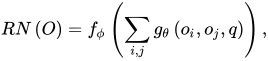
A relation network (RN) is an artificial neural network component with a structure that can reason about relations among objects. An example category of such relations is spatial relations (above, below, left, right, in front of, behind).[1]
RNs can infer relations, they are data efficient, and they operate on a set of objects without regard to the objects' order.[1]
In June 2017, DeepMind announced the first relation network. It claimed that the technology had achieved "superhuman" performance on multiple question-answering problem sets.[1]
| Dataset | Accuracy | Notes |
|---|---|---|
| CleVR (pixel) | 95.5% | Images of 3D objects, such as spheres and cylinders. Types of questions are: "attribute" queries ("What color is the sphere?", "compare attribute" queries ("Is the cube the same material as the cylinder?"), "count" queries ("How many spheres?") |
| CleVR (state description) | 96.4% | Images represented by state description matrices. Each row in the matrix contained a single object's features: coordinates (x, y, z); color (r, g, b); shape (cube, cylinder,...); material (rubber, metal,...); size (small, large,...). |
| Sort-of-CLEVR | 94% | 2D images along, each containing 6 squares and/or circles of 6 colors. Questions are coded as fixed-length binary numbers, eliminating natural language parsing complications. Each image serves 10 relational ("What is the shape of the object that is farthest from the gray object?") questions and 10 non-relational ("What is the shape of the gray object?") questions. |
| bAbI | 90% | Textual data. 20 tasks, each requiring a particular type of reasoning, such as deduction, induction, or counting. Each question is associated with a set of supporting sentences. For example, the sentences "Sandra picked up the football" and "Sandra went to the office" support the question "Where is the football?" (answer: "office"). Each sentence is processed separately. The success threshold is 95%. 10k entries. |
| Dynamic physical system | 93% connections
/95% counting |
Balls moving on a surface, with elastic and inelastic connections. One test determined whether pairs of balls were connected. The other determined how many were connected. |