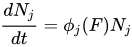
Here, we will show how relative nonlinearity can occur between two species. We will start by deriving the average growth rate of a single species. Let us assume that each species' growth rate depends on some density-dependent factor, F, such that
 ,
,
where Nj is species j's population density, and  is some function of the density-dependent factor F. For example, under a Monod chemostat model, F would be the resource density, and would be
  , where aj is the rate that species j can uptake the resource, and d is its death rate. In a classic paper by Armstrong and McGehee [1][cite Armstrong], was the a Type I functional response for one species and a Type II functional response for the other. We can approximate the per-capita growth rate,
 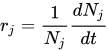 , using a Taylor series approximation as
 ,
,
where  is the average value of F. If we take the average growth rate over time (either over a limit cycle, or over an infinite amount of time), then it becomes
 ,
,
where  is the variance of F. This occurs because the average of
  is 0, and the average of
  is the variance of F. Thus, we see that a species' average growth rate is helped by variation if Φ is convex, and it is hurt by variation if Φ is concave.
We can measure the effect that relative nonlinearity has on coexistence using an invasion analysis. To do this, we set one species' density to 0 (we call this the invader, with subscript i), and allow the other species (the resident, with subscript r) is at a long-term steady state (e.g., a limit cycle). If the invader has a positive growth rate, then it cannot be excluded from the system. If both species have a positive growth rate as the invader, then they can coexist.[2]
Though the resident's density may fluctuate, its average density over the long-term will not change (by assumption). Therefore,  . Because of this, we can write the invader's density as

.[3] Substituting in our above formula for average growth, we see that
 .
.
We can rearrange this to
 ,
,
where  quantifies the effect of relative nonlinearity,
 .
.
Thus, we have partition the invader's growth rate into two components. The left term represents the variation-independent mechanisms, and will be positive if the invader is less hindered by a shortage of resources. Relative nonlinearity, will be positive, and thus help species i to invade, if  (i.e., if the invader is less harmed by variation than the resident). However, relative nonlinearity will hinder species i's ability to invade if
  .
.
Under most circumstances, relative nonlinearity will help one species to invade, and hurt the other. It will have a net positive impact on coexistence if its sum across all species is positive (i.e.,  for species j and k).[4] The
  terms will generally not change much when the invader changes, but the variation in F will. For the sum of the terms to be positive, the variation in F must be larger when the species with the more positive (or less negative)
  is the invader.


