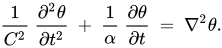
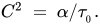
Heat conduction in a Newtonian context is modelled by the Fourier equation,[4] namely a parabolic partial differential equation of the kind:
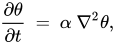 where θ is temperature,[5] t is time, α = k/(ρ c) is thermal diffusivity, k is thermal conductivity, ρ is density, and c is specific heat capacity. The Laplace operator,
  , is defined in Cartesian coordinates as
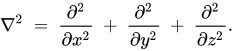
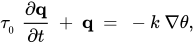
This Fourier equation can be derived by substituting Fourier's linear approximation of the heat flux vector, q, as a function of temperature gradient,
 into the first law of thermodynamics
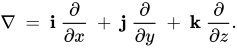
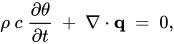 where the del operator, ∇, is defined in 3D as
It can be shown that this definition of the heat flux vector also satisfies the second law of thermodynamics,[6]
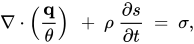 where s is specific entropy and σ is entropy production. This mathematical model is inconsistent with special relativity: the Green function associated to the heat equation (also known as heat kernel) has support that extends outside the light-cone, leading to faster-than-light propagation of information. For example, consider a pulse of heat at the origin; then according to Fourier equation, it is felt (i.e. temperature changes) at any distant point, instantaneously. The speed of propagation of heat is faster than the speed of light in vacuum, which is inadmissible within the framework of relativity.