Rendering equation
From Wikipedia, the free encyclopedia

In computer graphics, the rendering equation is an integral equation that expresses the amount of light leaving a point on a surface as the sum of emitted light and reflected light. It was independently introduced into computer graphics by David Immel et al.[1] and James Kajiya[2] in 1986. The equation is important in the theory of physically based rendering, describing the relationships between the bidirectional reflectance distribution function (BRDF) and the radiometric quantities used in rendering.
The rendering equation is defined at every point on every surface in the scene being rendered, including points hidden from the camera. The incoming light quantities on the right side of the equation usually come from the left (outgoing) side at other points in the scene (ray casting can be used to find these other points). The radiosity rendering method solves a discrete approximation of this system of equations.[1] In distributed ray tracing, the integral on the right side of the equation may be evaluated using Monte Carlo integration by randomly sampling possible incoming light directions. Path tracing improves and simplifies this method.[2]
The rendering equation can be extended to handle effects such as fluorescence (in which some absorbed energy is re-emitted at different wavelengths) and can support transparent and translucent materials by using a bidirectional scattering distribution function (BSDF) in place of a BRDF.[3] The theory of path tracing sometimes uses a path integral (integral over possible paths from a light source to a point) instead of the integral over possible incoming directions.[4]
The rendering equation may be written in the form


where
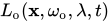
- is the total spectral radiance of wavelength directed outward along direction at time , from a particular position
- is the location in space
- is the direction of the outgoing light
- is a particular wavelength of light
- is time
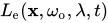
- is emitted spectral radiance
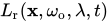
- is reflected spectral radiance
- is an integral over
- is the unit hemisphere centered around containing all possible values for where
- is the bidirectional reflectance distribution function, the proportion of light reflected from to at position , time , and at wavelength
- is the negative direction of the incoming light
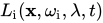
- is spectral radiance of wavelength coming inward toward from direction at time
- is the surface normal at
- is the weakening factor of outward irradiance due to incident angle, as the light flux is smeared across a surface whose area is larger than the projected area perpendicular to the ray. This is often written as .







Two noteworthy features are: its linearity—it is composed only of multiplications and additions, and its spatial homogeneity—it is the same in all positions and orientations. These mean a wide range of factorings and rearrangements of the equation are possible. It is a Fredholm integral equation of the second kind, similar to those that arise in quantum field theory.[5]
Note this equation's spectral and time dependence — may be sampled at or integrated over sections of the visible spectrum to obtain, for example, a trichromatic color sample. A pixel value for a single frame in an animation may be obtained by fixing motion blur can be produced by averaging over some given time interval (by integrating over the time interval and dividing by the length of the interval).[6]


Note that a solution to the rendering equation is the function . The function is related to via a ray-tracing operation: The incoming radiance from some direction at one point is the outgoing radiance at some other point in the opposite direction.

Applications
Solving the rendering equation for any given scene is the primary challenge in realistic rendering. One approach to solving the equation is based on finite element methods, leading to the radiosity algorithm. Another approach using Monte Carlo methods has led to many different algorithms including path tracing, photon mapping, and Metropolis light transport, among others.