Resistance distance
From Wikipedia, the free encyclopedia
In graph theory, the resistance distance between two vertices of a simple, connected graph, G, is equal to the resistance between two equivalent points on an electrical network, constructed so as to correspond to G, with each edge being replaced by a resistance of one ohm. It is a metric on graphs.
On a graph G, the resistance distance Ωi,j between two vertices vi and vj is[1]
- where

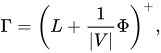
with + denotes the Moore–Penrose inverse, L the Laplacian matrix of G, |V| is the number of vertices in G, and Φ is the |V| × |V| matrix containing all 1s.
Properties of resistance distance
If i = j then Ωi,j = 0. For an undirected graph

General sum rule
For any N-vertex simple connected graph G = (V, E) and arbitrary N×N matrix M:

From this generalized sum rule a number of relationships can be derived depending on the choice of M. Two of note are;
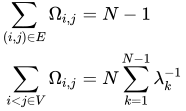
where the λk are the non-zero eigenvalues of the Laplacian matrix. This unordered sum

is called the Kirchhoff index of the graph.
Relationship to the number of spanning trees of a graph
For a simple connected graph G = (V, E), the resistance distance between two vertices may be expressed as a function of the set of spanning trees, T, of G as follows:
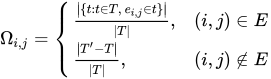
where T' is the set of spanning trees for the graph G' = (V, E + ei,j). In other words, for an edge 


Relationship to random walks
The resistance distance between vertices 



Resistance distance is also related to the escape probability between two vertices. The escape probability 

where 

As a squared Euclidean distance
Since the Laplacian L is symmetric and positive semi-definite, so is
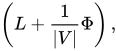
thus its pseudo-inverse Γ is also symmetric and positive semi-definite. Thus, there is a K such that 

showing that the square root of the resistance distance corresponds to the Euclidean distance in the space spanned by K.
Connection with Fibonacci numbers
A fan graph is a graph on n + 1 vertices where there is an edge between vertex i and n + 1 for all i = 1, 2, 3, …, n, and there is an edge between vertex i and i + 1 for all i = 1, 2, 3, …, n – 1.
The resistance distance between vertex n + 1 and vertex i ∈ {1, 2, 3, …, n} is
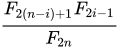
where Fj is the j-th Fibonacci number, for j ≥ 0.[4]
See also
References
- ↑ "Resistance Distance".
- ↑ Chandra, Ashok K and Raghavan, Prabhakar and Ruzzo, Walter L and Smolensky, Roman (1989). "The electrical resistance of a graph captures its commute and cover times". Proceedings of the twenty-first annual ACM symposium on Theory of computing - STOC '89. pp. 574–685. doi:10.1145/73007.73062. ISBN 0-89791-307-8.
{{cite book}}: CS1 maint: multiple names: authors list (link) - ↑ Doyle, Peter; Snell, J. Laurie (1984). Random Walks and Electric Networks. American Mathematical Society. ISBN 978-1-61444-022-2.
- ↑ Bapat, R. B.; Gupta, Somit (2010). "Resistance distance in wheels and fans" (PDF). Indian Journal of Pure and Applied Mathematics. 41 (1): 1–13. doi:10.1007/s13226-010-0004-2. MR 2650096.
- Klein, D. J.; Randic, M. J. (1993). "Resistance Distance". J. Math. Chem. 12: 81–95. doi:10.1007/BF01164627. S2CID 16382100.
- Gutman, Ivan; Mohar, Bojan (1996). "The quasi-Wiener and the Kirchhoff indices coincide". J. Chem. Inf. Comput. Sci. 36 (5): 982–985. doi:10.1021/ci960007t.
- Palacios, Jose Luis (2001). "Closed-form formulas for the Kirchhoff index". Int. J. Quantum Chem. 81 (2): 135–140. doi:10.1002/1097-461X(2001)81:2<135::AID-QUA4>3.0.CO;2-G.
- Babic, D.; Klein, D. J.; Lukovits, I.; Nikolic, S.; Trinajstic, N. (2002). "Resistance-distance matrix: a computational algorithm and its application". Int. J. Quantum Chem. 90 (1): 166–167. doi:10.1002/qua.10057.
- Klein, D. J. (2002). "Resistance Distance Sum Rules" (PDF). Croatica Chem. Acta. 75 (2): 633–649. Archived from the original (PDF) on 2012-03-26.
- Bapat, Ravindra B.; Gutman, Ivan; Xiao, Wenjun (2003). "A simple method for computing resistance distance". Z. Naturforsch. 58a (9–10): 494–498. Bibcode:2003ZNatA..58..494B. doi:10.1515/zna-2003-9-1003.
- Placios, Jose Luis (2004). "Foster's formulas via probability and the Kirchhoff index". Method. Comput. Appl. Probab. 6 (4): 381–387. doi:10.1023/B:MCAP.0000045086.76839.54. S2CID 120309331.
- Bendito, Enrique; Carmona, Angeles; Encinas, Andres M.; Gesto, Jose M. (2008). "A formula for the Kirchhoff index". Int. J. Quantum Chem. 108 (6): 1200–1206. Bibcode:2008IJQC..108.1200B. doi:10.1002/qua.21588.
- Zhou, Bo; Trinajstic, Nenad (2009). "The Kirchhoff index and the matching number". Int. J. Quantum Chem. 109 (13): 2978–2981. Bibcode:2009IJQC..109.2978Z. doi:10.1002/qua.21915.
- Zhou, Bo; Trinajstic, Nenad (2009). "On resistance-distance and the Kirchhoff index". J. Math. Chem. 46: 283–289. doi:10.1007/s10910-008-9459-3. hdl:10338.dmlcz/140814. S2CID 119389248.
- Zhou, Bo (2011). "On sum of powers of Laplacian eigenvalues and Laplacian Estrada Index of graphs". Match Commun. Math. Comput. Chem. 62: 611–619. arXiv:1102.1144.
- Zhang, Heping; Yang, Yujun (2007). "Resistance distance and Kirchhoff index in circulant graphs". Int. J. Quantum Chem. 107 (2): 330–339. Bibcode:2007IJQC..107..330Z. doi:10.1002/qua.21068.
- Yang, Yujun; Zhang, Heping (2008). "Some rules on resistance distance with applications". J. Phys. A: Math. Theor. 41 (44) 445203. Bibcode:2008JPhA...41R5203Y. doi:10.1088/1751-8113/41/44/445203. S2CID 122226781.