Retinomorphic sensor
From Wikipedia, the free encyclopedia

Retinomorphic sensors are a type of event-driven optical sensor which produce a signal in response to changes in light intensity, rather than to light intensity itself.[1] This is in contrast to conventional optical sensors such as charge coupled device (CCD) or complementary metal oxide semiconductor (CMOS) based sensors, which output a signal that increases with increasing light intensity. Because they respond to movement only, retinomorphic sensors are hoped to enable faster tracking of moving objects than conventional image sensors, and have potential applications in autonomous vehicles, robotics, and neuromorphic engineering.[2][3][4][5]
The first so-called artificial retina were reported in the late 1980s by Carver Mead and his doctoral students Misha Mahowald, and Tobias Delbrück.[6][7] These silicon-based sensors were based on small circuits involving differential amplifiers, capacitors, and resistors. The sensors produced a spike and subsequent decay in output voltage in response to a step-change in illumination intensity. This response is analogous to that of animal retinal cells, which in the 1920s were observed to fire more frequently when the intensity of light was changed than when it was constant.[8] The name silicon retina has hence been used to describe these sensors.[9]
The term retinomorphic was first used in a conference paper by Lex Akers in 1990.[10] The term received wider use by Stanford Professor of Engineering Kwabena Boahen, and has since been applied to a wide range of event-driven sensing strategies.[11] The word is analogous to neuromorphic, which is applied to hardware elements (such as processors) designed to replicate the way the brain processes information.
Operating principles

There are several retinomorphic sensor designs which yield a similar response. The first designs employed a differential amplifier which compared the input signal from of a conventional sensor (e.g. a phototransistor) to a filtered version of the output,[6] resulting in a gradual decay if the input was constant. Since the 1980s these sensors have evolved into much more complex and robust circuits.[1]
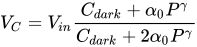
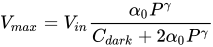
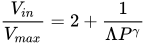
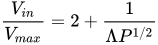
A more compact design of retinomorphic sensor consists of just a photosensitive capacitor and a resistor in series.[12] The output voltage of these retinomorphic sensors, , is defined as voltage dropped across the resistor. The photosensitive capacitor is designed to have a capacitance which is a function of incident light intensity. If a constant voltage , is applied across this RC circuit it will act as a passive high-pass filter and all voltage will be dropped across the capacitor (i.e. ). After a sufficient amount of time, the plates of the capacitor will be fully charged with a charge on each plate, where is the capacitance in the dark. Since under constant illumination, this can be simplified to .





If light is then applied to the capacitor it will change capacitance to a new value: . The charge that the plates can accommodate will therefore change to , leaving a surplus / deficit of charge on each plate. The excess charge will be forced to leave the plates, flowing either to ground or the input voltage terminal. The rate of charge flow is determined by the resistance of the resistor , and the capacitance of the capacitor. This charge flow will lead to a non-zero voltage being dropped across the resistor and hence a non-zero . After the charge stops flowing the system returns to steady-state, all the voltage is once again dropped across the capacitor, and again.




For a capacitor to change its capacitance under illumination, the dielectric constant of the insulator between the plates,[13] or the effective dimensions of the capacitor, must be illumination-dependent. The effective dimensions can be changed by using a bilayer material between the plates, consisting of an insulator and a semiconductor. Under appropriate illumination conditions the semiconductor will increase its conductivity when exposed to light, emulating the process of moving the plates of the capacitor closer together, and therefore increasing capacitance. For this to be possible, the semiconductor must have a low electrical conductivity in the dark, and have an appropriate band gap to enable charge generation under illumination. The device must also allow optical access to the semiconductor, through a transparent plate (e.g. using a transparent conducting oxide).
Applications
Conventional cameras capture every part of an image, regardless of whether it is relevant to the task. Because every pixel is measured, conventional image sensors are only able to sample the visual field at relatively low frame rates, typically 30–240 frames per second. Even in professional high speed cameras used for motion picture, the frame rate is limited to a few tens of thousands of frames per second for a full resolution image. This limitation could represent a performance bottleneck in the identification of high-speed moving objects. This is particularly critical in applications where rapid identification of movement is critical, such as in autonomous vehicles.
By contrast, retinomorphic sensors identify movement by design. This means that they do not have a frame rate and instead are event-driven, responding only when needed. For this reason, retinomorphic sensors are hoped to enable identification of moving objects much more quickly than conventional real-time image analysis strategies.[4] Retinomorphic sensors are therefore hoped to have applications in autonomous vehicles,[14][15] robotics,[16] and neuromorphic engineering.[17]





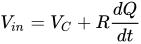


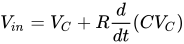
![{\displaystyle V_{in}=V_{C}+R{\bigg [}C{\frac {dV_{C}}{dt}}+V_{C}{\frac {dC}{dt}}{\bigg ]}}](https://wikimedia.org/api/rest_v1/media/math/render/svg/619a5f288fdd7ec91ad7a1731593638ba02af21d)
![{\displaystyle V_{out}=R{\bigg [}C{\frac {dV_{C}}{dt}}+V_{C}{\frac {dC}{dt}}{\bigg ]}}](https://wikimedia.org/api/rest_v1/media/math/render/svg/8d0937f35c9b1691565cb27df8134dacb4bf109b)


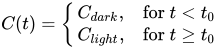




![{\displaystyle V_{in}=V_{C}+R{\bigg [}C{\frac {\Delta V_{C}}{\Delta t}}+V_{C}{\frac {\Delta C}{\Delta t}}{\bigg ]}}](https://wikimedia.org/api/rest_v1/media/math/render/svg/87ca524fef6b4f663c225bc73398718e024a432f)




![{\displaystyle V_{in}=V_{C}+R{\bigg [}C{\frac {V_{C}-V_{in}}{\Delta t}}+V_{C}{\frac {\alpha _{0}P^{\gamma }}{\Delta t}}{\bigg ]}}](https://wikimedia.org/api/rest_v1/media/math/render/svg/c86ee8c24565f57bfe4eb7ac660b54e9e30c59c3)


![{\displaystyle V_{in}\Delta t=V_{C}\Delta t+R{\bigg [}C(V_{C}-V_{in})+V_{C}\alpha _{0}P^{\gamma }{\bigg ]}}](https://wikimedia.org/api/rest_v1/media/math/render/svg/265fbbafae322b9bc89e7bc7f1b064394823215c)