Riesz rearrangement inequality
From Wikipedia, the free encyclopedia
In mathematics, the Riesz rearrangement inequality, sometimes called Riesz–Sobolev inequality, states that any three non-negative functions , and satisfy the inequality
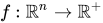
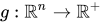


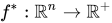
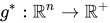
where , and are the symmetric decreasing rearrangements of the functions , and respectively.



The inequality was first proved by Frigyes Riesz in 1930,[1] and independently reproved by S.L.Sobolev in 1938. Brascamp, Lieb and Luttinger have shown that it can be generalized to arbitrarily (but finitely) many functions acting on arbitrarily many variables.[2]
Applications
The Riesz rearrangement inequality can be used to prove the Pólya–Szegő inequality.