A typical scoring method is composed of 3 components:[1]
- A set of consistent rules (or weights) that assign a numerical value ("points") to each risk factor that reflect our estimation of underlying risk.
- A formula (typically a simple sum of all accumulated points) that calculates the score.
- A set of thresholds that helps to translate the calculated score into a level of risk, or an equivalent formula or set of rules to translate the calculated score back into probabilities (leaving the nominal evaluation of severity to the practitioner).
Items 1 & 2 can be achieved by using some form of regression, that will provide both the risk estimation and the formula to calculate the score. Item 3 requires setting an arbitrary set of thresholds and will usually involve expert opinion.
Risk score are designed to represent an underlying probability of an adverse event denoted  given a vector of
  explanatory variables
  containing measurements of the relevant risk factors. In order to establish the connection between the risk factors and the probability, a set of weights
  is estimated using a generalized linear model:

Where ![{\displaystyle g^{-1}:\mathbb {R} \rightarrow [0,1]}](https://wikimedia.org/api/rest_v1/media/math/render/svg/6fdcabd4ed938c25385596a1a1242a02a05ca36c) is a real-valued, monotonically increasing function that maps the values of the linear predictor
is a real-valued, monotonically increasing function that maps the values of the linear predictor  to the interval
 ![{\displaystyle [0,1]}](https://wikimedia.org/api/rest_v1/media/math/render/svg/738f7d23bb2d9642bab520020873cccbef49768d) . GLM methods typically uses the logit or probit as the link function.
. GLM methods typically uses the logit or probit as the link function.
While it's possible to estimate 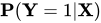 using other statistical or machine learning methods, the requirements of simplicity and easy interpretation (and monotonicity per risk factor) make most of these methods difficult to use for scoring in this context:
- With more sophisticated methods it becomes difficult to attribute simple weights for each risk factor and to provide a simple formula for the calculation of the score. A notable exception are tree-based methods such as CART, which can provide a simple set of decision rules and calculations but cannot ensure the monotonicity of the scale across the different risk factors.
- Because the goal is to estimate underlying risk across the population, individuals cannot be tagged in advance on an ordinal scale—it's not known in advance whether an observed individual belongs to a "high risk" group. Thus, classification methods are only relevant if individuals are to be classified into 2 groups or 2 possible actions.
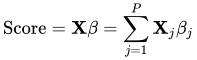
When using GLM, the set of estimated weights can be used to assign different values (or "points") to different values of the risk factors in (continuous or nominal as indicators). The score can then be expressed as a weighted sum:
- Some scoring methods will translate the score into probabilities by using
 (e.g. SAPS II score[2] that gives an explicit function to calculate mortality from the score[3]) or a look-up table (e.g. ABCD² score[4][5] or the ISM7 (NI) Scorecard[6]). This practice makes the process of obtaining the score more complicated computationally but has the advantage of translating an arbitrary number to a more familiar scale of 0 to 1.
- The columns of can represent complex transformations of the risk factors (including multiple interactions) and not just the risk factors themselves.
- The values of are sometimes scaled or rounded to allow working with integers instead of very small fractions (making the calculation simpler). While scaling has no impact ability of the score to estimate risk, rounding has the potential of disrupting the "optimality" of the GLM estimation.
Let  denote a set of
  "escalating" actions available for the decision maker (e.g. for credit risk decisions:
  = "approve automatically",
  = "require more documentation and check manually",
  = "decline automatically"). In order to define a decision rule, we want to define a map between different values of the score and the possible decisions in
  . Let
. Let  be a partition of
  into
into  consecutive, non-overlapping intervals, such that
  .
.
The map is defined as follows:

- The values of
 are set based on expert opinion, the type and prevalence of the measured risk, consequences of miss-classification, etc. For example, a risk of 9 out of 10 will usually be considered as "high risk", but a risk of 7 out of 10 can be considered either "high risk" or "medium risk" depending on context.
- The definition of the intervals is on right open-ended intervals but can be equivalently defined using left open-ended intervals
![{\displaystyle (\tau _{j-1},\tau _{j}]}](https://wikimedia.org/api/rest_v1/media/math/render/svg/9694675088156ab40ad8f0d6ff874364e5ccf90a) .
.
- For scoring methods that are already translated the score into probabilities we either define the partition directly on the interval or translate the decision criteria into
 , and the monotonicity of
  ensures a 1-to-1 translation.