Risālat al-Ṣūfī fī al-kawākib
From Wikipedia, the free encyclopedia
,_double_frontispiece._Ibn_al-Ṣūfī,_Risālat_al-Ṣūfī_fī_al-kawākib_Probably_Baghdad,_c._1225._Tehran,_Reza_Abbasi_Museum,_M._570.jpg) Old sage with a young prince (Ibn al-Ṣūfī and his patron-prince?), double frontispiece. Ibn al-Ṣūfī, Risālat al-Ṣūfī fī al-kawākib Probably Baghdad, c. 1225. Tehran, Reza Abbasi Museum (RAM), M. 570 | |
| Author | Ibn al-Ṣūfī (or one of his sons) |
|---|---|
| Original title | رسالة الصوفي في الكواكب |
| Language | Arabic |
| Subject | Astronomy |
| Genre | Poem |
| Published | 10th-11th century |
| Publication place | Rayy, Iran |
| Media type | Manuscript |
Risālat al-Ṣūfī fī al-kawākib (Arabic:رسالة الصوفي في الكواكب, "Epistle of al-Ṣūfī on the Stars"), is an 10-11th-century poem, probably composed in Rayy, Iran. It was authored by Ibn al-Ṣūfī, or most probably one of his sons.[1][2] It is a poetic supplement to Ibn al-Ṣūfī's astronomical opus The Book of Fixed Stars, in the urjūza genre.[3]
The text is known from a 13th century manuscript, possibly composed in Baghdad, now in Tehran, Reza Abbasi Museum (RAM M. 570), also called "RAM al'Sufi". It is stylistically dated to circa 1225.[1] An inscription in the manuscript gives a date of AH 554 (1159 CE), but this is probably a later interpolation.[4]
The manuscript has various depictions of the constellations, using various human and animal figures.[5] Several of the figures are wearing Turkic clothing, such as Centaurus, who has a Turkic sharbush headgear.[6]
Another Qajar copy exists, dated ̣to 1894 (Tehran, Majlis Library, no. 5099).[7]
 Title of Risālat al-Ṣūfī fī al-kawākib
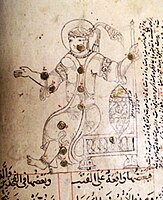 Cassiopeia. Ibn al-Ṣūfī, p. 24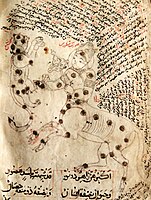
 Aquila. Ibn al-Ṣūfī, p. 31
 Ursa Minor. Ibn al-Ṣūfī, p. 5
.jpg)


.jpg)
.jpg)