Robertson graph
From Wikipedia, the free encyclopedia
In the mathematical field of graph theory, the Robertson graph or (4,5)-cage, is a 4-regular undirected graph with 19 vertices and 38 edges named after Neil Robertson.[2][3]

| Robertson graph | |
|---|---|
The Robertson graph is Hamiltonian. | |
| Named after | Neil Robertson |
| Vertices | 19 |
| Edges | 38 |
| Radius | 3 |
| Diameter | 3 |
| Girth | 5 |
| Automorphisms | 24 (D12) |
| Chromatic number | 3 |
| Chromatic index | 5[1] |
| Book thickness | 3 |
| Queue number | 2 |
| Properties | Cage Hamiltonian |
| Table of graphs and parameters | |
The Robertson graph is the unique (4,5)-cage graph and was discovered by Robertson in 1964.[4] As a cage graph, it is the smallest 4-regular graph with girth 5.
It has chromatic number 3, chromatic index 5, diameter 3, radius 3 and is both 4-vertex-connected and 4-edge-connected. It has book thickness 3 and queue number 2.[5] The graph is neither planar nor 1-planar.[6]
The Robertson graph is also a Hamiltonian graph which possesses 5,376 distinct directed Hamiltonian cycles.
The Robertson graph is one of the smallest graphs with cop number 4.[7]
Algebraic properties
The Robertson graph is not a vertex-transitive graph; its full automorphism group is isomorphic to the dihedral group of order 24, the group of symmetries of a regular dodecagon, including both rotations and reflections.[8]
The characteristic polynomial of the Robertson graph is


Gallery
 The Robertson graph as drawn in the original publication.
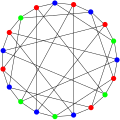 The chromatic number of the Robertson graph is 3.
 The chromatic index of the Robertson graph is 5.


