Room in Brooklyn
From Wikipedia, the free encyclopedia
| Room in Brooklyn | |
|---|---|
 | |
| Artist | Edward Hopper |
| Year | 1932 |
| Medium | Oil on canvas |
| Dimensions | 73.98 cm × 86.36 cm (29⅛ in × 34 in) |
| Location | Museum of Fine Arts, Boston |
| Accession | 35.66 |
Room in Brooklyn is a 1932 oil on canvas painting by the American artist Edward Hopper. It depicts a woman in a rocking chair inside an apartment, looking out a bay window at an apartment building, with sunlight entering the room. Hopper improvised and completed the work at his Greenwich Village studio around the same time as its possible companion piece, Room in New York.
The painting evokes the style of Caspar David Friedrich through its use of the Rückenfigur motif and also shows the influence of fellow realist John Sloan, whose interior city scenes Hopper admired. Continuing his long-running exploration of figures in sunlit rooms, Room in Brooklyn is his only major painting to include flowers, since Hopper generally disliked painting them.
The work was first exhibited that year at the Modern American Paintings show at the Carnegie Institute, alongside his previous painting, Chop Suey (1929). It is held in the collection of the Museum of Fine Arts, Boston.
Inside a building, a room that has a bay window with three visible brown sashes looks out from what appears to be a top-floor apartment. The window overlooks a cityscape filled with brick-red buildings and chimneys; a blue sky appears above, fringed by three green window curtains indoors. A green carpet lies in a mostly unadorned room. A round table with a blue covering holds a vase full of pink and white flowers near a window on the right.
Sunlight streams in and falls on the table, the vase, and the carpet, continuing across the left side of the room. Here, a woman wearing a blue garment, possibly a dressing gown, sits in a yellow-brown rocking chair facing a window; she is seen only from behind. She appears to be leaning forward as if reading, but her hands are not visible. A table covered with red cloth sits behind her. The painting is signed "Edward Hopper" in the lower right corner.
Background
The early 1930s were a productive and successful time for Hopper, full of sales and recognition for his art.[1] Artist and critic Guy Pène du Bois sang Hopper's praises in the literature,[2] commending both Hopper and his colleague Charles E. Burchfield, who were often compared. Hopper had himself previously interviewed Burchfield and published an article about his work.[3] In 1931 alone, Hopper sold 30 paintings.[4] The next year, Hopper and his wife Josephine Nivison ("Jo") moved into a larger, top-floor apartment at 3 Washington Square North in Greenwich Village with a view facing Washington Square Park, and remained there for the rest of their lives.[5]

The National Academy of Design announced in March 1932 that they had elected Hopper to their ranks, but Hopper declined their membership.[6] Hopper had long been unhappy by the way he was treated. The Academy, a conservative gatekeeper of new American art,[a] had spent many years turning down his submissions.[8] This time of his life, lasting roughly 15 years, was described as one of "disappointment and discouragement".[9] By the early 1920s, Hopper had only sold two paintings,[9] but there was still demand for his etchings, with Hopper producing dozens from 1915 to 1923.[10] When the Academy elected Hopper, The New York Times reported that the organization "considered a stronghold of conservatism, departed from its traditional paths...by electing...an artist of the modern school, Edward Hopper."[6]
Jo was instrumental in helping Hopper jump-start his career, though in later years he was reticent to admit it. Previously, in 1923, they painted watercolors together in Gloucester, Massachusetts, becoming romantically involved that summer.[11] Jo exhibited her watercolors in a group show at the Brooklyn Museum, persuading the organizers to let Hopper participate. They accepted, with the critics mostly ignoring her submissions and praising Hopper instead.[12] They married the following year.[13] After his first showing at the Frank K.M. Rehn Gallery in 1924, Hopper was able to quit commercial art and devote himself to fine art full-time.[14]
Museums first began acquiring his work in 1925 with Apartment Houses (1923) entering the collection of the Pennsylvania Academy of the Fine Arts.[15] The Museum of Modern Art (MoMA) added House by the Railroad (1925) in 1930.[16] Room in New York appeared at the first Whitney Biennial in the fall of 1932.[17] The MoMA hosted Hopper's first retrospective exhibition in 1933.[18]
Development

Hopper started painting Room in Brooklyn at the beginning of 1932.[4] It was improvised, although Jo's story behind the work is disputed by curator Carol Troyen.[19] Jo said Hopper had planned to paint the Brooklyn Bridge outside the window, but when it came time, he discovered it would not work. Hopper was worried about "clutter", recalls Jo, forcing him to eliminate the bridge idea. Jo said that it was entirely unclear if any remnants of Brooklyn remained in the final painting once Hopper decided not to paint the bridge.[4] Curator Carol Troyen is skeptical of this explanation, since there was little room in the painting to accommodate a bridge.[19]
Hopper completed the painting in February along with its possible pendant, Room in New York.[19] It depicts a couple sitting in the same room, distant from each other. The man is seen reading a newspaper while the woman sits across from him with a bored look, about to strike a key on a piano.[4]
Style
Alfred H. Barr Jr., the first director of the Museum of Modern Art, described the painting, along with Hotel Room (1931), as sharing precise, well-defined forms ("the whetting of edges") and vivid color that created a formal intensity ("approaching harshness").[20] Critics have described Hopper as a modern realist painter, portraying realism in his subject matter while expressing modernism in his formal compositions. Troyen argues that Barr initially presented Hopper as a modernist for political reasons in an attempt to appeal to factions seeking both contemporary and more radically modernist works for the museum's collection. In the same catalog, however, Hopper dismissed abstract art as merely decorative. Troyen maintains that Hopper's modernist style at this time more closely resembled the late-19th-century work of Paul Cézanne and the Precisionism of Charles Sheeler.[21]
Caspar David Friedrich

The painting is suggestive of the style of several different artists. Many art historians have noted the influence of the style of Caspar David Friedrich on Hopper's work. Friedrich, a 19th century German Romantic painter, was known for his use of the Rückenfigur, a motif showing a solitary figure seen only from behind who gazes out at a landscape. David Anfam believed that Hopper was aware of Friedrich.[23] "Hopper's taste for German culture," writes Anfam, "may have alerted him more than most to the then-obscure Friedrich."[24] Hopper had studied the German language, made use of German motifs in his early work, and displayed knowledge of the German art tradition.[25]
Hopper traveled to Europe three times. In his first trip, he spent ten months in Europe from the fall of 1906 until the summer of 1907. He visited Paris, London, Amsterdam, Berlin, and Brussels.[26] Hopper was in Berlin in July, spending less than a week in the city. This was at a time when the German public had just rediscovered Friedrich, whose work was shown in the Exhibition of German Art of the Century one year earlier. Scholar Margaret Iversen compares Room in Brooklyn with Friedrich's Woman at a Window (1822).[27]
John Sloan
John Sloan was influential in Hopper's life from around the time of World War I until the early 1920s.[28] Hopper wrote positively about Sloan in 1927, anticipating his own embrace of many of Sloan's themes.[29] According to art historian Robert Hobbs, Sloan was known for portraying everyday people engaged in solitary activities within buildings, in eating establishments and theaters, and in seascapes and scenes from modern city life. While Hopper draws from much of Sloan's work, and they were both realists associated with the Ashcan School, a term they mutually disliked and disavowed, they were also very different people.[28]

Echoes of Sloan's etchings and paintings can be found in several of Hopper's works during this time. His etching of Evening Wind (1921) evokes Sloan's Turning Out the Light (1905), while Room in Brooklyn is reminiscent of Sloan's The Women's Page (1905), notably as a source for the figure of the woman in the chair. Hobbs argues that the woman in the chair is similar to the popular image of women sewing from 18th and 19th century art, except Hopper turned the image away from the viewer. For Hobbs, Hopper "makes her anonymous as the mass of undifferentiated Brooklyn tenements outside the window".[28]

In works such as A Window on the Street (1912), Sloan drew on the Pre-Raphaelites and earlier Renaissance traditions, focusing on women in interiors. Hopper stripped this tradition bare, favoring a stark modern realism of urban spaces and unidentified people in apartments. These differences extended to their personal lives: Sloan supported left-wing causes and workers' rights in illustrations for socialist newspapers, while Hopper made his living as a commercial illustrator.[28]
Although his commercial work promoted business interests, he also undermined[c] similar ideas in his fine art.[32] Hopper avoided expressing political positions[d] in his own work.[36] Regarding the etching East Side Interior (1922), he told a curator in 1956, "No implication was intended with any ideology concerning the poor and oppressed. The interior itself was my main interest—simply a piece of New York, the city that interests me so much."[37]
Themes
Art historian Theodore Stebbins once described the painting as a "lonely urban scene".[38] Other art historians like Louis Shadwick believe the painting moves beyond the usual Hopperian clichés of loneliness and alienation, suggesting that a more multilayered perspective and interpretation is possible. Shadwick writes that the richly colored palette and the figure framed in sunlight suggest something more subtle and nuanced.[31]
According to Art historian Gail Levin, Hopper's etchings refined and cultivated his depiction of the solitary female figure in urban interior spaces.[39] Evening Wind (1921) marks Hopper's first nude in this theme to be fully realized with technical proficiency, with East Side Interior (1922) and paintings like Moonlight Interior (1921-23) and Eleven A.M. (1926) continuing to focus on this subject.[40] Levin argues that Room in Brooklyn is compositionally reminiscent of Hopper's older etching of The Bay Window (1915–1918), which features a woman sewing near a window.[41] Like Shadwick, Levin also acknowledges that critics have overstated the loneliness in much of Hopper's work, but finds it to be most true for his etchings, as they were made before his marriage to Jo.[42]
Hopper preferred to depict scenes in rooms looking out through a window in daylight, but there are exceptions where he used night instead.[43] Troyen notes that Room in Brooklyn is part of Hopper's long-running exploration of figures in sunlit rooms, a theme beginning with Summer Interior (1909) and culminating decades later in Sun in an Empty Room (1963), by which time the figure has been removed entirely.[44]
 The Bay Window (1915–1918)
 Evening Wind (1921)
 East Side Interior (1922)
 Eleven A.M. (1926)


_by_American_artist_Edward_Hopper.jpg)
Setting
The row houses in Room in Brooklyn resemble urban architecture in Hopper's other New York works produced in the five years before the painting, including The City (1927), From Williamsburg Bridge (1928), and Early Sunday Morning (1930), the latter loosely depicting structures once found on Seventh Avenue.[45] Many of the buildings Hopper depicts in his New York paintings no longer exist, having since been demolished and replaced by newer structures.[46] Hopper's paintings of New York, as Shadwick observes, document significant changes in the city's historical development.[31] In response to the city's transformation, Hopper and his wife campaigned to preserve the older architecture in their Greenwich Village neighborhood throughout their lives.[46]
 The City (1927)
 From Williamsburg Bridge (1928)
 Early Sunday Morning (1930)


Flowers
At his Cape Cod summer home and studio in South Truro, Massachusetts, Hopper told art critic Brian O'Doherty in 1963 that Room in Brooklyn was the only painting of cut flowers in his entire catalog. "I don't care very much for flowers", he recalled. "In all the work I've done there's only one painting with flowers, Room in Brooklyn, a little vase on the table with flowers...the so-called beauty is all there. You can't add anything to them of your own—yourself...the unsophisticated think there's something inherent in it...A pond with lilies or something. There isn't of course."[47] While Room in Brooklyn is the only painting[e] by Hopper to depict flowers,[48] he had featured flowers in the background of his outdoor paintings earlier in his career, including in Railroad Train (1908), painted in an Impressionist-influenced style following his recent trip to Paris,[49] and in Rocks and Houses, Ogunquit (1914), completed during his time on the coast of Maine.[50]
| External image | |
|---|---|
 Edward and Jo Hopper, 1933. Photograph by Louise Dahl-Wolfe. Whitney Museum of American Art. Edward and Jo Hopper, 1933. Photograph by Louise Dahl-Wolfe. Whitney Museum of American Art. |
Unlike Hopper, Jo was fond of depicting flowers in her work.[f] She painted still-life watercolors of vases of flowers and, separately, fruit baskets, which she featured in exhibitions and successfully sold.[51] Jo had a preference for flowers in her home, whether in New York or Cape Cod.[52] Painter Raphael Soyer, who knew the Hoppers, recalled visiting them in Greenwich Village in 1955 and seeing Jo's paintings of flowers displayed in her studio.[53]
In an interview, Jo explained she resisted painting flowers in the beginning as she thought that was what women were supposed to paint, but a closer look changed her mind: "...one day when at a loss for subject matter my skirt brushed against some lovely petunias, zinnias—most arresting creatures, really...they were so enchanting, I marveled at the exquisite tilt of the petals and the gesture of the long stems, so friendly, living their tossed lives in the teeth of east winds and ocean spray.... I felt they should be painted."[51]

Art historian Elizabeth Thompson Colleary proposes that both Hopper and Jo shared the same subject matter in this regard, with fruit baskets in her watercolors like Green and White Fruit Basket (1930) also showing up in Hopper's Tables for Ladies (1930). Hopper's use of the flower vase in Room with Brooklyn likely has the same origin, with Colleary describing the flower vase in Hopper's painting as one of Jo's "still-life subjects".[51] Jo's use of fruit baskets and flower bouquets held great personal meaning for her, as they were often gifts which they had received from friends. The fruit basket in Tables for Ladies, for example, was given to them by their friend Bee Blanchard.[51]
Hopper spent years denigrating the painting of flowers as a subject fit only for "Lady Flower Painters". Levin argues that Hopper did not just scorn his wife's art, but also expressed an overt kind of sexism: "Hopper envisioned no creative role for women, including his wife", writes Levin. "His attitude toward women typifies most male artists of his generation. He was consistent in his disparagement of women artists in general, viewing them mainly as dilettantes who painted flowers, dabbled in other trivial subjects, and caused trouble for men in the profession."[54]
Provenance
Hopper consigned the painting to his art dealer, Frank K.M. Rehn, in February 1932.[4] It was exhibited at least five times[55] before the Museum of Fine Arts, Boston, bought the painting in May 1935 for $1,800[56] ($42,269 in 2025), under the direction of its third curator, George H. Edgell, who had an interest in modern art.[57] The purchase was supported by the Charles Henry Hayden Fund[g] (Hayden Collection).[60]
Selected exhibitions

The painting was originally exhibited shortly after it was completed, first appearing alongside Hopper's earlier work, Chop Suey (1929), at the Modern American Paintings exhibition at the Department of Fine Arts, Carnegie Institute, from April 28 to May 30, 1932.[61]
- Modern American Paintings (Carnegie Institute, 1932)[55]
- Edward Hopper: Retrospective Exhibition (MoMA, 1933)[62]
- Hopper (Arts Club of Chicago, 1934)[55]
- 41st American Annual (Cincinnati Art Museum, 1934)[55]
- Twenty-First Annual (Toledo Museum, 1934)[55]
- Hopper, (Carnegie Institute, 1937)[55]
- 54th American Annual (Chicago Art Institute, 1943)[55]
- Hopper (Whitney Museum of American Art, 1950)[55]
- 26th Venice Biennale (1952)[55]
- Edward Hopper: Retrospective Exhibition (Whitney Museum of American Art, 1964)[10]
- Edward Hopper (MFA Boston, 2007)[63]
- Edward Hopper's New York (Whitney Museum of American Art, 2022)[31]
Edward Hopper's New York (2022), an exhibition curated by Kim Conaty, showed 200 works by Hopper divided by theme. Room in Brooklyn was exhibited in a group of paintings categorized as "The Window" in the following set: New York Interior (1921), New York Restaurant (1922), Automat (1927), Drug Store (not pictured, 1927), Night Windows (1928), Tables for Ladies (pictured above, 1930), Room in Brooklyn, (pictured above, 1932), and Room in New York (pictured above, 1932).[64]
 New York Interior (1921)
 New York Restaurant (1922)
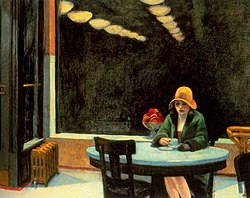 Automat (1927)
 Night Windows (1928)
.jpg)


