Rotational Brownian motion (astronomy)
From Wikipedia, the free encyclopedia
In astronomy, rotational Brownian motion is the random walk in orientation of a binary star's orbital plane, induced by gravitational perturbations from passing stars.
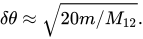
Consider a binary that consists of two massive objects (stars, black holes etc.) and that is embedded in a stellar system containing a large number of stars. Let and be the masses of the two components of the binary whose total mass is . A field star that approaches the binary with impact parameter and velocity passes a distance from the binary, where






the latter expression is valid in the limit that gravitational focusing dominates the encounter rate. The rate of encounters with stars that interact strongly with the binary, i.e. that satisfy , is approximately where and are the number density and velocity dispersion of the field stars and is the semi-major axis of the binary.




As it passes near the binary, the field star experiences a change in velocity of order
,

where is the relative velocity of the two stars in the binary. The change in the field star's specific angular momentum with respect to the binary, , is then Δl ≈ a Vbin. Conservation of angular momentum implies that the binary's angular momentum changes by Δlbin ≈ -(m/μ12)Δl where m is the mass of a field star and μ12 is the binary reduced mass. Changes in the magnitude of lbin correspond to changes in the binary's orbital eccentricity via the relation e = 1 - lb2/GM12μ12a. Changes in the direction of lbin correspond to changes in the orientation of the binary, leading to rotational diffusion. The rotational diffusion coefficient is



where ρ = mn is the mass density of field stars.
Let F(θ,t) be the probability that the rotation axis of the binary is oriented at angle θ at time t. The evolution equation for F is [1]
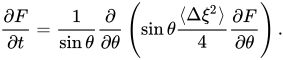
If <Δξ2>, a, ρ and σ are constant in time, this becomes
![{\displaystyle {\partial F \over \partial \tau }={1 \over 2}{\partial \over \partial \mu }\left[(1-\mu ^{2}){\partial F \over \partial \mu }\right]}](https://wikimedia.org/api/rest_v1/media/math/render/svg/883f0e9ab38c104c505746d22ed8a4939592e138)
where μ = cos θ and τ is the time in units of the relaxation time trel, where
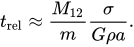
The solution to this equation states that the expectation value of μ decays with time as

Hence, trel is the time constant for the binary's orientation to be randomized by torques from field stars.