The angular momentum density of a fluid element is written either as an antisymmetric tensor ( ) or, equivalently, as a pseudovector. As a tensor,
the equation for the conservation of angular momentum for a simple fluid with no external forces is written:
) or, equivalently, as a pseudovector. As a tensor,
the equation for the conservation of angular momentum for a simple fluid with no external forces is written:

where  is the fluid velocity and
  is the total pressure tensor (or, equivalently, the negative of the total stress tensor). Note that the Einstein summation convention is used, where summation is assumed over pairs of matched indices. The angular momentum of a fluid element can be separated into extrinsic angular momentum density due to the flow (
 ) and intrinsic angular momentum density due to the rotation of the fluid particles about their center of mass (
 ):
):

where the extrinsic angular momentum density is:

and  is the mass density of the fluid element. The conservation of linear momentum equation is written:
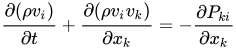
and it can be shown that this implies that:

Subtracting this from the equation for the conservation of angular momentum yields:
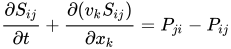
Any situation in which this last term is zero will result in the total pressure tensor being symmetric, and the conservation of angular momentum equation will be redundant with the conservation of linear momentum. If, however, the internal rotational degrees of freedom of the particles are coupled to the flow (via the velocity term in the above equation), then the total pressure tensor will not be symmetric, with its antisymmetric component describing the rate of angular momentum exchange between the flow and the particle rotation.
In the linear approximation for this transport of angular momentum, the rate of flow is written:[1]: p.308

where  is the average angular velocity of the rotating particles (as an antisymmetric tensor rather than a pseudovector) and
  is the rotational viscosity coefficient.