Royal Academy Exhibition of 1902
From Wikipedia, the free encyclopedia
_-_King_Edward_VII_(1841-1910)_-_RCIN_404553_-_Royal_Collection.jpg)
The Royal Academy Exhibition of 1902 was the hundred and thirty forth annual Summer Exhibition of the British Royal Academy of Arts which was held at Burlington House in London's Piccadilly from 5 May to 4 August 1902.[1] It marked the first full exhibition of the Edwardian era, as the previous Exhibition of 1901 had been overshadowed by mourning for Queen Victoria.
A centrepiece of the exhibition was the Coronation Portrait of Edward VII by Luke Fildes which showed the new monarch in his full regalia and had been painted during the winter months. The slightly delayed Coronation of Edward VII and Alexandra took place on 9 August, just after the Exhibition had closed.[2] Another well-received painting of the king displayed was The Reception of the Moorish Ambassador by Edward VII at St James's Palace by John Seymour Lucas.[3]
In general, the exhibition was noted for its portraiture, which was seen to return to the dominance it had shown during the eighteenth century and Regency era. In particular John Singer Sargent displayed eight portraits. These included The Acheson Sisters and Lord Ribblesdale. It was the last time works by the animal painter Thomas Sidney Cooper featured. He had displayed paintings at the Royal Academy for seventy consecutive exhibitions since the Royal Academy Exhibition of 1833.[4]
Alfred Munnings displayed his breakthrough work The Vagabonds, later described as his magnum opus. [5] Walter Langley of the Newlyn School of artists displayed A Cornish Idyll.[6] The veteran of the Victorian era William Powell Frith displayed a genre painting In the Conservatory.[7]
Portraits
 The Reception of the Moorish Ambassador by Edward VII at St James's Palace by John Seymour Lucas
 A Cornish Idyll by Walter Langley
 A Venetian Water Seller by Henry Woods
 Chadding in Mounts Bay by Stanhope Forbes
 Off for the Honeymoon by Frederick Morgan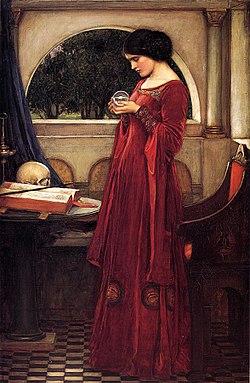
 The Missal by John William Waterhouse
 Bolton Abbey by David Murray
 A Deep Sea Idyll by Herbert James Draper
 Aphrodite by Briton Rivière
 The Last Ray by George Dunlop Leslie
 In Suffolk Marshes by Ernest Albert Waterlow
 Washington's Farewell to the Army by Andrew Carrick Gow
 Absence Makes the Heart Grow Fonder by Marcus Stone
 Forget Me Not by Arthur Hughes
 Homewards by George Clausen
 Market Morning by Yeend King
 Hera in the House of Hephaistos by William Blake Richmond
 Salmon Fishing on the Dee by Joseph Farquharson
 Through the Crisp Air by Joseph Farquharson
 The Run Home by Henry Scott Tuke
 An idyll of Como by Alfred East
 The Valley of the Lambourne by Alfred East
 Sleeping Nymphs Discovered by a Shepherd by Robert Fowler
 George II at the Battle of Dettingen by Robert Alexander Hillingford
 La Belle Dame sans Merci by Frank Dicksee
 Watching the Invaders by Hubert von Herkomer
 The Borgia by William Quiller Orchardson
 Paolo and Francesca by Christopher Williams

_-_A_Cornish_Idyll_-_WAG_408_-_Walker_Art_Gallery.jpg)
_-_Venetian_Water_Seller_-_WAGMG_,_1902.122_-_Warrington_Museum_and_Art_Gallery.jpg)


.jpg)
.png)


_-_Suffolk_Marshes_-_TWCMS_,_F3495_-_Laing_Art_Gallery.jpg)

.png)

.png)
_-_Market_Morning_-_PA-161_-_The_Whitaker.jpg)


,_Ruby,_gold_and_malachite,_1902.jpg)


_-_Sleeping_Nymphs_Discovered_by_a_Shepherd_-_WAG_2822_-_Walker_Art_Gallery.jpg)


_-_Watching_the_Invaders_-_WAG_2932_-_Walker_Art_Gallery.jpg)

.jpg)


 Portrait of Ellen Peabody Endicott by John Singer Sargent
 Portrait of Alfred Wertheimer by John Singer Sargent
 The Misses Hunter by John Singer Sargent
 Portrait of the Duchess of Portland by John Singer Sargent
 Portrait of Matilda Hirsch by John Singer Sargent
 Portrait of Lady Lady Meysey-Thompson by John Singer Sargent
 Portrait of Nellie Melba by Rupert Bunny
 Portrait of Lady Marjorie Manners by James Jebusa Shannon
 Portrait of Lord Egerton by Hubert von Herkomer
 Portrait of Henry Trueman Wood by Hubert von Herkomer
 Portrait of Richard Pilkington by Arthur Stockdale Cope
 Portrait of Joseph Cockfield Dimsdale by Arthur Stockdale Cope
 Portrait of John Leng by William Quiller Orchardson
 Portrait of William Holman Hunt by Ralph Peacock
 Portrait of Blanche Marchesi by Solomon Joseph Solomon
 Portrait of Phil May by James Jebusa Shannon
 Portrait of Francis Charrington by Henry Tanworth Wells
 Portrait of Edwin Grove by Henry Tanworth Wells
 Portrait of James Bell Pettigrew by Walter William Ouless
 Portrait of Lilian Braithwaite by Charles Sims
 Portrait of Mrs W. K. D'Arcy by Frank Dicksee
.jpg)


_-_Alfred,_Son_of_Asher_Wertheimer_-_N03709_-_National_Gallery.jpg)
_-_The_Misses_Hunter_-_N04180_-_National_Gallery.jpg)
,_Duchess_of_Portland.jpg)


_-_Lady_Marjorie_Manners_(1883–1946),_Later_Marchioness_of_Anglesey,_Aged_17_-_1175973_-_National_Trust.jpg)
_-_Wilbraham_Egerton_(1832–1909),_Earl_^_2nd_Baron_Egerton_of_Tatton_-_1298223_-_National_Trust.jpg)
_-_Sir_Henry_Trueman_Wood,_Secretary_and_Vice-President_of_the_Society_of_Arts_-_RSA008_-_Royal_Society_of_Arts.jpg)

.png)
_-_Sir_John_Leng_(1828–1906),_MP_(1889–1905)_-_95-1912_-_Dundee_Art_Galleries_and_Museums.jpg)
.jpg)

_-_Phil_May_-_N03825_-_National_Gallery.jpg)


