Rudolf Muradyan's main research is in theoretical physics, elementary particle physics, high-energy physics, cosmology and mathematical physics.[3]
In 1969, based on the quasi-free quark model, Rudolf Muradyan, together with Albert Tavkhelidze and Victor Matveev, proposed that the scaling properties of high-energy electron-nucleon interaction processes found in experiments are common to all deep inelastic lepton-hadron processes. Muradyan, Tavkhelidze and Matveev have developed an automodelicity (self-similarity) principle on the basis of which these properties may be derived directly. According to this principle, many characteristics of processes in the field of high energies and high momentum transfer, including particle form factors, do not depend on characteristic length and momentum scaling of dimensional parameters. They are homogeneous functions of relativistically invariant kinematical variables and a degree of homogeneity of these functions is determined by their physical dimensionality. A scale law describing the mass spectrum of muon pairs produced at high energies in proton  hadrons collisions was first established using the principle of automodelicity:
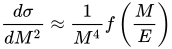
Where  is the effective mass of the muon pair and
  is the energy of the colliding particles. This sweeping law was confirmed in experimental studies begun in 1970 by Leon Lederman's group at Brookhaven. Subsequently, it was in these processes that a new class of hadrons -
  particles - were discovered.[12]
In 1973, based on the principle of self-similarity, the so-called "Matveev-Muradyan-Tavkhelidze quark counting rules" were established. They define the asymptotics of the form factors at large momentum transfer  as well as the nature of the energy dependence of the differential cross section of an arbitrary binary scattering reaction at large angles at high energies
  :
:
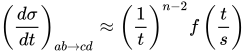
Where  is the total number of elementary hadron components participating in the reaction. In this case
  if the particle
  is a structureless lepton. The function
  depends only on the ratio of large kinematic variables. It is a dimensional quantity and the natural scale here is the effective particle size. The power asymptotic law indicates factorization of large and small distance effects.[12] In 1987 in the State Register of Discoveries of the USSR the discovery (№343) "Rule of quark counting by Matveev-Muradyan-Tavkhelidze" was registered.[6] In 1970-1980s Rudolf Muradyan together with his colleagues performed a significant cycle of works on application of the automodelicity principle and generalization of quark counting rules for multiple and inclusive processes using a three-dimensional formulation of quantum field theory. According the resolution of the Central Committee of the Communist Party of the Soviet Union and Council of Ministers of April 15, 1988, Rudolf Muradyan together with his colleagues was awarded the Lenin Prize for the cycle of studies on the dynamic regularities in the quark structure of elementary particles and atomic nuclei (1965-1977).[13]
Muradyan investigated the emergence of the Universe, stars, galaxies from an initial hadron, as well as the connection between the appearance of the Universe's rotation and magnetic fields and the cosmological constant  . In 1976, he discovered a new expression for the angular momentum of the rotation of the Universe:
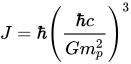
Where  is the Dirac constant,
  is the speed of light,
  is the gravitational constant, and
  is the proton mass. Muradyan's proposed hypothesis of the emergence of the Universe, related to Victor Hambardzumian's theory of the emergence of the Universe, allows to explain the appearance of the rotation of space objects (stars, galaxies and others) in a quantitative way, based on the known relationship in the physics of elementary particles between mass and rotation momentum.[3] In 1970, Rudolf Muradyan gave an exact solution to the problem of "random walks" on the sphere and in Lobachevsky space. In 1981 he proposed a direct and unified method for constructing irreducible representations for all discrete subgroups of a three-dimensional rotation group, especially for the triangle, tetrahedron and octahedron groups. In 1998, investigating Hopf structures in n-Li - Nambu algebras, he introduced the fundamental concepts of 3-coalgebras, 3-algebras and 3-algebras of Hopf.
In 1990 Rudolf Muradyan proposed the new form of Mendelev's Periodic Table: the system in which the order of the elements is determined not by the sequence number, but by the structure of the electron shell filling of the atom. This table of elements is based on the quantum-mechanical structure of the atom, and has certain convenience and clarity.[1]
.svg) Armenian SSR
Armenian SSR.svg) USSR
USSR Brazil


