The transfer characteristic of an object can be represented as a power series:
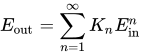
Or, taking only the first few terms (which are most relevant),

For an ideal perfect linear object K2, K3, K4, K5, etc. are all zero. A good connection approximates this ideal case with sufficiently small values.
For a 'rusty bolt' (or an intentionally designed frequency mixer stage), K2, K3, K4, K5, etc. are not all zero. These higher-order terms result in generation of harmonics.
The following analysis applies the power series representation to an input sine-wave.
If the incoming signal is a sine wave {Ein sin(ωt)}, (and taking only first-order terms), then the output can be written:

Clearly, the harmonic terms will be worse at high input signal amplitudes, as they increase exponentially with the amplitude of Ein.
To understand the generation of nonharmonic terms (frequency mixing), a more complete formulation must be used, including higher-order terms. These terms, if significant, give rise to intermodulation distortion.
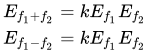
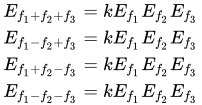
Hence the second-order, third-order, and higher-order mixing products can be greatly reduced by lowering the intensity of the original signals (f1, f2, f3, f4, …, fn)


