SIN R1
From Wikipedia, the free encyclopedia
| SIN R1 | |
|---|---|
_(cropped).jpg) SIN R1 at the 2014 Goodwood Festival of Speed | |
| Overview | |
| Manufacturer | SIN Cars |
| Production | 2015–present |
| Designer | Rosen Daskalov |
| Body and chassis | |
| Class | Sports car (S) |
| Layout | Rear mid-engine, rear-wheel-drive |
| Doors | Butterfly doors |
| Powertrain | |
| Engine |
|
| Power output | 450–650 hp (336–485 kW; 456–659 PS) |
| Transmission | 6-speed manual |
| Dimensions | |
| Wheelbase | 2,760 mm (108.7 in) |
| Length | 4,830 mm (190.2 in) |
| Width | 2,000 mm (78.7 in) |
| Height | 1,285 mm (50.6 in) |
| Curb weight | 1,250 kg (2,760 lb) |
The SIN R1 is a sports car made by Bulgarian manufacturer SIN Cars.
Rosen Daskalov, the founder of SIN Cars & former racing driver, was working with a British business partner in the United Kingdom in 2012. After disagreements they split and Daskalov moved the company to his hometown and continued developing the R1.[1]
Specifications
The R1 features an FIA-certified tube frame construction, being built around a strong, heavy and relatively easy-to-make tubular spaceframe chassis rather than a carbon fiber monocoque. It features carbon fiber bodywork and an active rear spoiler. It came with 3 engine choices – LS3 (6.2-liter N/A V8), LS7 (7.0-liter N/A V8) and an LS9 (6.2-liter supercharged V8).[2][3] The standard transmission was a 6-speed manual, with a sequential paddleshift gearbox offered on some models, sending power to a limited-slip differential.[4] The brakes are supplied by AP Racing and the dampers by Öhlins. It has double wishbone suspension all around with in-board mounted springs and dampers. The car weighs 1,250 kg (2,760 lb)[5] and has a top speed of 300 km/h (186 mph). The 7.0-liter naturally aspirated engine has its pistons and bearings replaced with high-performance items. A dry sump lubrication system is better fitted for track driving, which means the engine can be positioned lower in the chassis – and it uses a bespoke, part-titanium exhaust.
The R1 series includes 3 models (450, 550 & 650) for road and 2 models (VTX & GT4) for track. The first R1 was revealed in track-only prototype form in 2013 at the Autosport International show. In 2014, a road-going prototype was shown. The R1 will be[needs update] produced no more than 20 units annually.
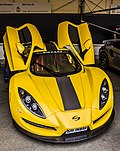 Sin R1 at the 2014 Goodwood Festival of Speed
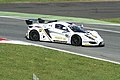 SIN R1 at R2 of the 2016 Competition102 GT4 European Series at Monza
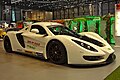 Sin R1 550 Hybrid at the 2018 Geneva Motor Show
.jpg)
.jpg)


