SMS Kaiser Max (1862)
From Wikipedia, the free encyclopedia
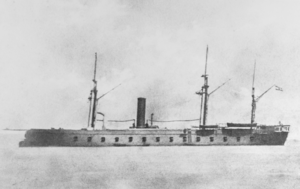 Illustration of Kaiser Max c. 1866 | |
| History | |
|---|---|
 Austrian Empire Austrian Empire | |
| Name | Kaiser Max |
| Builder | Stabilimento Tecnico Triestino |
| Laid down | October 1861 |
| Launched | 14 May 1862 |
| Commissioned | 1863 |
| Fate | Scrapped, December 1873 |
| General characteristics | |
| Class & type | Kaiser Max class |
| Displacement | 3,588 long tons (3,646 t) |
| Length | 70.78 m (232 ft 3 in) pp |
| Beam | 10 m (32 ft 10 in) |
| Draft | 6.32 m (20 ft 9 in) |
| Installed power | 1,926 indicated horsepower (1,436 kW) |
| Propulsion |
|
| Speed | 11.4 knots (21.1 km/h; 13.1 mph) |
| Range | 1,200 nautical miles (2,200 km; 1,400 mi) at 10 knots (19 km/h; 12 mph) |
| Crew | 386 |
| Armament |
|
| Armor | Belt: 110 mm (4.3 in) |
SMS Kaiser Max was the lead ship of the Kaiser Max class of armored frigates built for the Austrian Navy in the 1860s. Her keel was laid in October 1861 at the Stabilimento Tecnico Triestino shipyard; she was launched in May 1862, and was completed in 1863. She carried her main battery—composed of sixteen 48-pounder guns and fifteen 24-pounders—in a traditional broadside arrangement, protected by an armored belt that was 110 mm (4.3 in) thick.
Kaiser Max saw action at the Battle of Lissa in July 1866. She engaged the Italian coastal defense ship Palestro, which later exploded and sank after sustaining heavy Austrian fire. Kaiser Max emerged from the battle largely unscathed, save for minor damage to her funnel and rigging inflicted by the armored frigate Re d'Italia. After the war, Kaiser Max was modernized slightly in 1867 to correct her poor seakeeping and improve her armament, but she was nevertheless rapidly outpaced by naval developments in the 1860s and 1870s. Obsolescent by 1873, Kaiser Max was officially "rebuilt", though in actuality she was broken up for scrap, with only her armor plate, parts of her machinery, and other miscellaneous parts being reused in the new Kaiser Max.
Having already secured funding for the two Drache-class ironclads, the head of the Austrian Navy, Archduke Ferdinand Max, argued in 1862 for an expanded fleet of ironclad warships as part of the Austro-Italian ironclad arms race. He requested a total force of nine ironclads, which would counter the known construction program of the Italian Regia Marina—then at four ironclads already ordered, with more funding authorized for future vessels. For 1862, he proposed building three ironclads, along with converting a pair of sail frigates to steam frigates. The Austrian Reichsrat (Imperial Council) refused to grant funding for the program, but Kaiser Franz Joseph intervened and authorized the navy to place orders for the new ships, which became the Kaiser Max class.[1]
Kaiser Max was 70.78 meters (232 ft 3 in) long between perpendiculars; she had a beam of 10 m (32 ft 10 in) and an average draft of 6.32 m (20 ft 9 in). She displaced 3,588 long tons (3,646 t). She had a crew of 386. Her propulsion system consisted of one single-expansion steam engine that drove a single screw propeller. The number and type of her coal-fired boilers have not survived. Her engine produced a top speed of 11.4 knots (21.1 km/h; 13.1 mph) from 1,926 indicated horsepower (1,436 kW). She could steam for about 1,200 nautical miles (2,200 km; 1,400 mi) at a speed of 10 knots (19 km/h; 12 mph).[2]
Kaiser Max was a broadside ironclad, and she was armed with a main battery of sixteen 48-pounder muzzle-loading guns and fifteen 24-pounder 15 cm (5.9 in) rifled muzzle-loading guns. She also carried a single 12-pounder gun and a six-pounder. The ship's hull was sheathed with wrought iron armor that was 110 mm (4 in) thick.[2]
