SUBCLU takes two parameters,  and
and  , which serve the same role as in DBSCAN. In a first step, DBSCAN is used to find 1D-clusters in each subspace spanned by a single attribute:





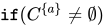




- // In a second step,
 -dimensional clusters are built from
  -dimensional ones:








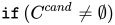




The set  contains all the -dimensional subspaces that are known to contain clusters. The set
  contains the sets of clusters found in the subspaces. The
  is chosen to minimize the runs of DBSCAN (and the number of points that need to be considered in each run) for finding the clusters in the candidate subspaces.
Candidate subspaces are generated much alike the Apriori algorithm generates the frequent itemset candidates: Pairs of the -dimensional subspaces are compared, and if they differ in one attribute only, they form a -dimensional candidate. However, a number of irrelevant candidates are found as well; they contain a -dimensional subspace that does not contain a cluster. Hence, these candidates are removed in a second step:






- // Pruning of irrelevant candidate subspaces
-





