San Leonardo, Nueva Ecija
Municipality in Nueva Ecija, Philippines
From Wikipedia, the free encyclopedia
San Leonardo, officially the Municipality of San Leonardo (Tagalog: Bayan ng San Leonardo), is a municipality in the province of Nueva Ecija, Philippines. According to the 2024 census, it has a population of 69,180 people.[5]

San Leonardo | |
|---|---|
| Municipality of San Leonardo | |
Welcome arch | |
 Seal | |
 Map of Nueva Ecija with San Leonardo highlighted | |
 Interactive map of San Leonardo | |
.svg)  San Leonardo Location within the Philippines | |
| Coordinates: 15°21′40″N 120°57′44″E | |
| Country | Philippines |
| Region | Central Luzon |
| Province | Nueva Ecija |
| District | 4th district |
| Barangays | 15 (see Barangays) |
| Government | |
| • Type | Sangguniang Bayan |
| • Mayor | Froilan A. Nagaño |
| • Vice Mayor | Amerigus B. Nagaño |
| • Representative | Emerson D. Pascual |
| • Municipal Council | Members |
| • Electorate | 45,858 voters (2025) |
| Area | |
• Total | 151.90 km2 (58.65 sq mi) |
| Elevation | 29 m (95 ft) |
| Highest elevation | 51 m (167 ft) |
| Lowest elevation | 18 m (59 ft) |
| Population (2024 census)[3] | |
• Total | 69,180 |
| • Density | 455.4/km2 (1,180/sq mi) |
| • Households | 17,243 |
| Economy | |
| • Income class | 1st municipal income class |
| • Poverty incidence | 11.65 |
| • Revenue | ₱ 303.7 million (2024) |
| • Assets | ₱ 1,439 million (2024) |
| • Expenditure | ₱ 299.7 million (2024) |
| • Liabilities | ₱ 555.6 million (2024) |
| Service provider | |
| • Electricity | Nueva Ecija 2 Area 2 Electric Cooperative (NEECO 2 A2) |
| Time zone | UTC+8 (PST) |
| ZIP code | 3102 |
| PSGC | |
| IDD : area code | +63 (0)44 |
| Native languages | Tagalog Ilocano |
| Website | www |
History
PRE- COLONIAL SAN LEONARDO
San Leonardo was a vast forest inhabited by various species of animals, birds, and plants. The first inhabitants of San Leonardo were the Negritos. Before becoming a town, San Leonardo was called Maniclin. The Negritos, also called Ita or Baluga, survived by hunting and gathering fruits and medicinal herbs in the dense forest.
The Origin of the Name Maniclin
The name Maniclin originates from oral history and folklore. It is derived from the word maninikling, which refers to the catching of the tikling bird (striped crake) that once densely nested in that area.
According to the local legend, a group of local men holding baskets and snares was about to leave when five Spanish soldiers on horseback arrived. The soldiers asked for the name of the place, but the men—thinking the soldiers were asking where they were going—simultaneously replied:
"Maninikling, maninikling po kami" ("We are going to catch tikling birds").
Misinterpreting the response as the name of the location, one of the soldiers muttered, "¿Este se llama Maniclin?" ("So this place is called Maniclin?") before whipping their horses to move on. From then on, the Spanish soldiers assigned to the pueblo of Gapan referred to the area as Maniclin, which eventually evolved into the town of San Leonardo, Nueva Ecija.
Maniclin, Mambangnan, Tambo, Nieves, San Anton, and Castellano were visitas or barrios of Gapan, under the administration of the Three Kings parish. Due to the growing population in Intramuros and the suburbs or arrabales of Manila, the Chinese arrived. The Gremio de Mestizos de Sangley, half of the Principalia, descended from this lineage. Meanwhile, people from Bulacan arrived who cleared the land through slash-and-burn farming (kaingin), driving the Negritos into the mountains. Kapampangans settled in Mambangnan and Nieves. Natives of Gapan cleared land in Castellano, while people from Jaen cleared vast tracts of land in San Anton. In Tambo, Kapampangans from Apalit, Pampanga settled, bringing along their devotion to Saint Peter the Apostle, or "Apung Iru."
SAN LEONARDO AS A TOWN AND AS A PARISH
Before the Revolution against Spain (1890), the Principalia of Maniclin submitted a petition to the Spanish government to make Maniclin an independent town, separate from Gapan, and have a resident priest in the church. A Royal Order was issued on October 11, 1894, in the name of King Alfonso XIII of Spain, authorizing the establishment of a parish, school, and cemetery in Maniclin, which was to be named San Leonardo. However, due to a shortage of priests, the request could not be granted immediately. Fathers Francisco Arriola, OSA, and Nicanor Gonzales, OSA, were the visiting priests who went to celebrate Masses.
In August 1896, the formal inauguration of the new town and parish took place. Saint Bartholomew the Apostle remained the patron saint, a devotion that began when the area was still just a visita of Gapan. By 1897, the number of parishioners exceeded 7,093. Fray Ángel de la Heras, OSA, was appointed as the first resident parish priest.
On August 1, the central government formally declared the creation of a new civil town named "San Leonardo," separate from the town of Gapan. It comprised the barrios of Maniclin, Mambangnan, Nieves, Castellano, San Anton, and Tambo.
The Libro de Bautismo (Baptismal Book) was granted to the parish on April 21, 1896. This was followed by the issuance from Manila of the parish's Libro de Matrimonios (Marriage Book) and Libro de Entierros (Burial Book) on April 28, 1896. This latter date is "also" believed to be the day San Leonardo became an independent town. In May 1896, Father Angel de las Heras, OSA, was appointed its first parish priest, a decision formally signed by Archbishop Bernardino Nozaleda y de Villa, OP. Archbishop of Manila.
The newly established parish was tested by fate when the Revolution against the Spaniards, led by Andres Bonifacio, broke out. The fire of the revolution spread rapidly until it reached Nueva Ecija. The First Cry of Nueva Ecija took place on September 2, 1896, led by General Mariano Llanera and General Pantaleon Valmonte. Many young men from Maniclin, Mambangnan, and Nieves joined as revolutionaries under General Valmonte's group. On the night of September 3, 1896, the new parish was broken into by the revolutionaries, who destroyed the iron box used for church alms.
The first Capitan Municipal (now equivalent to a Municipal Mayor) was Benito Pestaño (3 April 1860 – 11 October 1919). When Maniclin officially became a full-fledged town and transitioned into the new town of San Leonardo, he governed the newly established town from 1894 to 1901. The Capitan Municipal was the official title for the highest local leader of a town during the Spanish colonial period in the Philippines, particularly following the implementation of the Maura Law in 1893.
Following Benito Pestaño's leadership during the turn of the century, local history notes that the subsequent municipal leaders of San Leonardo were Lauricio Longalong and Juan Candelaria. Under their administration during the early period of American occupation, the newly established municipality faced severe hardships.
Following the end of the Philippine-American War, a civil government was established in Nueva Ecija in 1901. On June 19, 1901, Jacob F. Krepps (22 October 1860 – 10 June 1929) was appointed as the first civil governor of the province. He served from June 19, 1901, to March 3, 1902. In 1902, a powerful typhoon accompanied by a severe storm struck San Leonardo, causing widespread destruction of homes and severe damage to the citizens' crops. Because of the fury of this storm, the original Casa Tribunal—locally known as the Bantayan—collapsed and was destroyed. To ensure the continuity of governance and public service, the municipal office was temporarily relocated to the house of Sabas Pestaño and Jose Azarcon. Later, due to the growing administrative responsibilities and functions of the town, Bantayan was moved once again to a larger house owned by Doña Bartola Sanchez.
Aside from natural calamities, San Leonardo also faced a severe financial crisis due to declining revenues in the town treasury. Local earnings were insufficient to meet the expenses and needs of an independent town. Consequently, the provincial government of Nueva Ecija decided to temporarily annex San Leonardo to the neighboring town of Peñaranda from 1906 to 1907 to achieve financial consolidation.
SAN LEONARDO IN THE REVOLUTIONARY GOVERNMENT
Many young men from Maniclin, San Leonardo, joined the revolutionary movement. They served as soldiers under the leadership of General Urbano Lacuna and Captain Pablo Padilla of Peñaranda, Nueva Ecija. Among the recorded participants were Saturnino from Tambo and Sario from Maniclin.
One of the notable figures originating from San Leonardo was Venancio Garcia (16 April 1869 – 18 October 1970) from Mambangnan. According to local accounts, he became a part of the Katipunan and served as a soldier under General Antonio Luna. Through his service, he reached the rank of Lieutenant.
Lt. Garcia was associated with the Tiradores de la Muerte unit, or the elite sharpshooters belonging to General Luna's army. He was described as a soft-spoken, humble, brave, and loyal soldier of the Republic. Because of his loyalty and prowess in warfare, it was reported that General Luna appointed him as the leader of the Guardia Negra, an elite group of soldiers tasked with carrying out dangerous missions against the enemy.
Following the establishment of the Revolutionary Government by General Emilio F. Aguinaldo, the reorganization of provinces liberated from the Spanish government was carried out. Nueva Ecija was reorganized on July 7, 1898, and Don Felino Cajucom was appointed as civil governor.
As an important center of the revolutionary movement, Nueva Ecija was divided into four military zones according to the order of General Aguinaldo. San Leonardo was included in the second military zone under the leadership of Don Pablo A. Padilla and Don Angelo San Pedro.
SAN LEONARDO IN THE PHILIPPINE-AMERICAN WAR
On July 4, 1900, the Battle of Maniclin took place. This battle was not simply an encounter between two armies; it was a complex scene that showcased the tactical skill of the Filipinos and the unique racial dynamics within the United States military. Under the leadership of General Urbano A. Lacuna (26 May 1862 – 10 April 1911), about 700 Filipino guerrillas launched a strategic, simultaneous attack on American garrisons in Peñaranda, Gapan, and Maniclin.
Lacuna used July 4, American Independence Day, to carry out the assault. This was a symbolic move aimed at reminding the invaders that Filipinos were also fighting for their own freedom. Lacuna's guerrilla tactics dealt a major surprise to the United States Army forces in Central Luzon.
The Battle of Maniclin held an important aspect: the presence of African-American soldiers. The garrison in Maniclin was guarded by Company C of the 24th U.S. Infantry, a regiment composed of black soldiers also known in history as "Buffalo Soldiers." While white soldiers of the 34th U.S. Volunteers were assigned to neighboring towns, these black soldiers directly met Lacuna's forces in Maniclin.
Despite experiencing discrimination in their own country, many of the Buffalo Soldiers bravely fought for the American flag. This resulted in the failure of the Filipinos' plan to completely capture the garrison. However, this battle also opened the door to psychological warfare.
Filipino revolutionaries were well aware of the oppression experienced by black people in America. Therefore, before and after battles such as the one in Maniclin, Filipinos distributed leaflets urging the Buffalo Soldiers not to fight their "brown-skinned brothers." This interaction prompted some black soldiers to ultimately question what they were fighting for, while others completely turned their backs on the U.S. Army to side and fraternize with the Philippine revolutionary army.
On October 27, 1899, an important clash took place between Filipino soldiers and American forces at the Tabuating River. This event was part of the continuing Filipino resistance against the expanding control of the United States over the country.
Brigadier General Samuel Baldwin Marks Young led two battalions of the 22nd Infantry Regiment of the American army. His group remained in San Isidro and sent reinforcements at daybreak.
Before the Americans arrived, Filipino soldiers destroyed the bridge in Tambo to hinder their advance. Because of this, a skirmish ensued that pushed the Americans toward Tabuating.
According to records, Filipino soldiers received additional support on the night of October 26, 1899. Meanwhile, the American group led by Captain John G. Ballance consisted of five officers and approximately 380 soldiers.
Filipino soldiers built roughly 800 yards of trenches on the opposite bank of the Tabuating River as defense against the advancing Americans. Amidst the battle, both sides utilized various tactics to secure the strategic position.
In this battle, it was reported that thirteen Filipino soldiers were killed and twenty-six were wounded. Despite the fierce fighting, the identities of most of the Filipinos who participated in the clash remain unclear in existing records.
SAN LEONARDO DURING THE JAPANESE OCCUPATION
Japanese soldiers entered and occupied San Leonardo in the early part of 1942, specifically between January and May of that year, coinciding with their rapid advance into the province of Nueva Ecija during World War II.
Life back then seemed normal due to the efforts of the Japanese to win the goodwill of the citizens. Turmoil only arose when they conducted "zones" or "zonification." Their military police, who excessively abused and spread fear among the Filipinos back then, were called the Kempeitai (or Kenpeitai). Also present were the Makapilis (Makabayang Katipunan ng mga Pilipino).
This referred to a militant Filipino group formed in 1944 during World War II that cooperated with the Imperial Japanese Army to point out and report fellow Filipinos who were fighting against guerrilla movements or uprisings.
Its members were known for wearing a bayong with eyeholes (referred to as a "bayong" or "spy") when pointing out suspected guerrillas so that they could not be recognized by their neighbors.
The Makapili guerrilla unit was established in Mambangnan. Due to the large number of Japanese soldiers stationed in Mambangnan, it came to be dubbed "Little Tokyo" (Ritoru Tōkyō).
In Barangay Mambangnan, they established a garrison, and near the visita of Mambangnan, the Japanese soldiers practiced their drills. Japanese soldiers could be seen carrying their rifles, known as the Arisaka rifle, famously equipped with a bayonet.
They set up a checkpoint in the area where the large artesian well—known as the Magsaysay well—formerly stood. Japanese soldiers also taught basic words and phrases in Nihonggo, such as: Greetings—Ohayou gozaimasu (Good morning); Konnichiwa (Good afternoon / Hello); Konbanwa (Good evening); Oyasumi nasai (Good night; before sleeping); Sayounara (Goodbye). Daily Phrases—Arigatou gozaimasu (Thank you very much); Doi itashimashite (You're welcome); Sumimasen (Excuse me / Sorry); Gomen nasai (Forgiveness / I'm sorry); Hai (Yes); Iie (No).
The Japanese soldiers dug holes into the large mango trees in the barrio, where they placed their equipment.
The youth of San Leonardo were once again tested by fate to prove their bravery and loyalty to the country. In 1944, approximately twenty (20) young men enlisted as soldiers and formed a guerrilla company called Squadron 217. Squadron 217 (or the 217th Squadron) was a prominent group of Filipino guerrillas who fought against the Japanese in Luzon. They were known as part of the Luzon Guerrilla Armed Forces (LGAF) or units allied with the USAFFE (United States Army Forces in the Far East) who refused to surrender after the fall of Bataan and Corregidor.
The Squadron 217 group was led by Captain Alfredo de la Cruz. This group secretly headed to Mount Basal and requested weapons there, which were delivered via a submarine landing in Baler.
Squadron 217 engaged the Japanese soldiers in battle several times. Guinandusan and Pambuan, within the jurisdiction of Gapan, served as their hiding place, and they were always ready to attack the Japanese soldiers garrisoned in Mambangnan. Battles between the Japanese and the guerrillas frequently occurred in the fields. Barangay Magpapalayoc was burned down by Japanese soldiers; many were tortured, and some were even killed.
LIBERATION AND THE ESTABLISHMENT OF CIVIL GOVERNMENT (1945)
The Americans arrived in Nueva Ecija on February 1, 1945. When the occupying Japanese forces were finally driven out of the country, a new day of freedom dawned for the people of Central Luzon. The strategic diplomacy and heroism displayed by local leaders in the midst of the war resulted in an orderly and peaceful transition toward community reconstruction. On February 4, 1945, the town's official deliverance from the Japanese took place. Guerrillas who had long fought and hid bravely emerged from the forests and mountains, where they were joyfully greeted by the entire town of San Leonardo celebrating their freedom.² Following this historic event, Colonel Dioscoro M. de Leon, the commander of the guerrillas who occupied and liberated the districts of Gapan, Peñaranda, Papaya (now General Tinio), and San Leonardo, arrived in the town center to formally re-establish the civil government in the area.
To ensure the stability and order of the newly freed municipality, military and civil authorities recognized the extraordinary contribution of the former police chief. Due to his proven leadership and rescue of the townspeople during the dark era, Rosendo Sanchez was formally reassigned as the municipal mayor of San Leonardo. His assumption of office marked the official end of the Japanese regime and opened the door for extensive post-war reconstruction and the revival of agriculture, commerce, and civil institutions across the six original barrios of San Leonardo under the free flag of the Philippines.
DELIVERANCE OF THE TOWN FROM THE JAPANESE
The following day, on February 5, 1945, a Holy Mass was offered by Rev. Fr. Vicente L. Navarro at the parish as a heartfelt thanksgiving by the entire community to God for their survival and liberation from the war. Following over a year of Mayor Rosendo Sanchez's leadership under the transitional civil government, the local administration underwent another change. On July 18, 1946, Isidro Sanchez was formally appointed as the new mayor, the honorable leader who had previously served as the town's very first mayor at the start of the Commonwealth in 1935. On this occasion, he succeeded his younger brother, Rosendo, in office. Isidro Sanchez's tenure during this period lasted for only one year. His administration concluded to pave the way for the impending nationwide elections to choose a new President, Vice President, Senators, and Representatives to the Congress of the newly established Third Philippine Republic.
Both Rosendo and Isidro Sanchez served for one year each following the liberation of San Leonardo from Japanese hands, but their respective administrations will never be forgotten by the citizens. Because the town was in such a delicate phase of history, upon the shoulders of the Sanchez brothers rested the heavy responsibility of pacifying remaining conflicts, rehabilitating destroyed institutions, and reviving the livelihood of a town that had greatly suffered and been devastated under the cruel Japanese occupation.
Sources:
Baroman, Cesar C. Nueva Ecija 1896–1946. Cabanatuan City: Nueva Ecija Historical, Cultural and Arts Council, 1993. Buzeta, Manuel, and Felipe Bravo. Diccionario geográfico, estadístico, histórico, de las Islas Filipinas. 2 vols. Madrid: 1850–1851. Crisóstomo, Isabelo T. Governor Eduardo L. Joson: The Gentle Lion of Nueva Ecija. Quezon City: J. Kriz Publishing Enterprises, 1989.
“Errecion de los Pueblos Nueva Ecija.” Catalog. San Leonardo (1779-1898) SDS Number: 1407, Exp. 15, Place/Document: 11 de octubre de 1894, S568-572B. “Comunicación de la Real Orden de 11 de octubre último, aprobando la creación de una parroquia en el barrio Manicling del Pueblo de Gapan en Nueva Ecija.” (1731-1899).
El Comercio: Periódico de la tarde, diario industrial, mercantil, agrícola y de anuncios. Manila, Philippines. August 1, 1896.
Fr. Angel Perez, OSA. Relaciones Agustinianas de las Razas del Norte de Luzon. 1904.
Fr. Isacio Rodríguez, OSA. Historia de la Provincia Agustiniana del Santísimo Nombre de Jesús. 20 Vols. 1965.
Cura del Almas. Compiled and annotated by Regalado Trota Jose. 4 Vols. Manila: UST Publishing House, 2008.
Funston, Frederick. Memories of Two Wars: Cuban and Philippine Experiences. London: Constable & Co. Ltd., 1912.
Garcia, Kennedy C. "ANG SAN LEONARDO, NUEVA ECIJA SA PANAHON NG HIMAGSIKANG PILIPINO–KASTILA AT DIGMAANG PILIPINO–AMERIKANO (1896–1899) AT PANAHON NG HAPON (1941–1945)." April 12, 2002.
Gatewood, Willard B. “Smoked Yankees” and the Struggle for Empire: Letters from Negro Soldiers, 1898–1902. Fayetteville: University of Arkansas Press, 1987.
Gleeck, Lewis E., Jr. Nueva Ecija in American Times: A Homesteaders' Frontier. Manila: Historical Conservation Society / R.P. Garcia Publishing Inc., 1981.
José, Regalado Trota, comp. Curas de Almas: A Preliminary Listing of Parishes and Parish Priests in the 19th Century Philippines Based on the Guias de Forasteros, 1834–1898*. 4 vols. Manila: UST Publishing House, 2008.
Jose, Vivencio R. The Rise and Fall of Antonio Luna. Quezon City: Anvil Publishing, 2015.
McLennan, Marshall S. The Central Luzon Plain: Land and Society on the Inland Frontier. Quezon City: Alemar-Phoenix Publishing House, 1980.
United States War Department. Annual Reports of the War Department for the Fiscal Year Ended June 30, 1900: Report of the Lieutenant-General Commanding the Army. Vol. 1, pt. 7. Washington, D.C.: Government Printing Office, 1900. archive.org.
Geography
The municipality has a land area of 151.90 square kilometers or 58.65 square miles which constitutes 2.67% of Nueva Ecija's total area. This represented 2.97% of the total population of Nueva Ecija province, or 0.55% of the overall population of the Central Luzon region. Based on these figures, the population density is computed at 451 inhabitants per square kilometer or 1,169 inhabitants per square mile.[6]
San Leonardo is located between Gapan and Santa Rosa along the Maharlika Highway. It is 15 kilometres (9.3 mi) from Cabanatuan, 29 kilometres (18 mi) from Palayan, and 101 kilometres (63 mi) from Manila.
Barangays
San Leonardo is politically subdivided into 15 barangays, as shown below. Each barangay consists of puroks and some have sitios.
- Bonifacio (Población)
- Burgos (Población)
- Castellano
- Diversion
- Magpapalayoc
- Mallorca
- Mambangnan
- Nieves
- Rizal (Población)
- San Anton
- San Bartolomé (Población)
- San Roque
- Tabuating
- Tagumpay
- Tambo-Adorable
Climate
| Climate data for San Leonardo, Nueva Ecija | |||||||||||||
|---|---|---|---|---|---|---|---|---|---|---|---|---|---|
| Month | Jan | Feb | Mar | Apr | May | Jun | Jul | Aug | Sep | Oct | Nov | Dec | Year |
| Mean daily maximum °C (°F) | 28 (82) |
30 (86) |
31 (88) |
33 (91) |
33 (91) |
31 (88) |
30 (86) |
29 (84) |
29 (84) |
30 (86) |
30 (86) |
29 (84) |
30 (86) |
| Mean daily minimum °C (°F) | 20 (68) |
20 (68) |
20 (68) |
22 (72) |
24 (75) |
24 (75) |
24 (75) |
24 (75) |
24 (75) |
23 (73) |
22 (72) |
21 (70) |
22 (72) |
| Average precipitation mm (inches) | 4 (0.2) |
4 (0.2) |
5 (0.2) |
11 (0.4) |
66 (2.6) |
99 (3.9) |
127 (5.0) |
113 (4.4) |
99 (3.9) |
84 (3.3) |
35 (1.4) |
14 (0.6) |
661 (26.1) |
| Average rainy days | 2.2 | 1.9 | 3.2 | 5.3 | 16.1 | 20.8 | 23.5 | 22.8 | 22.2 | 16.5 | 8.9 | 3.5 | 146.9 |
| Source: Meteoblue[7] | |||||||||||||
Demographics
Population census of San Leonardo | |||||||||||||||||||||||||||||||||||||||||||||||||||||||
|
| ||||||||||||||||||||||||||||||||||||||||||||||||||||||
| Source: Philippine Statistics Authority[8][9][10][11][12] | |||||||||||||||||||||||||||||||||||||||||||||||||||||||
Religion
A majority of the populace is Roman Catholic. Other religious groups, mostly Christian, have churches and places of worship in the municipality.
- St. Bartholomew the Apostle Parish Church
- St. John Marie Vianney Parish
- St. Jude Thaddeus of Nueva Ecija
- Ss. Peter and Paul Catholic Chapel - Magpapalayoc
- Bethel United Methodist Church
- Iglesia Ni Cristo - Lokal ng Castellano
- Iglesia Ni Cristo - Lokal ng Nieves
- Iglesia Ni Cristo - Lokal ng San Leonardo
- Iglesia Ni Cristo - Lokal ng Magpapalayok
- Iglesia Ni Cristo - Lokal ng Tabuating
- Iglesia Ni Cristo - Lokal ng Balanga Extension
- Iglesia Ni Cristo - Lokal ng San Anton
- Iglesia Ni Cristo - Lokal ng San Roque
- Jesus Christ to God be the Glory Church International
- Leap of Faith Christian Church
- Pentecostal Missionary Church of Christ (4th Watch)
- United Pentecostal Church - San Leonardo
- Victory Churches of Asia, Incorporated
Economy
Poverty incidence of San Leonardo
35.44
16.69
19.80
13.63
12.21
15.84
5.14
11.65
Source: Philippine Statistics Authority[13][14][15][16][17][18][19][20]

Primarily depends on rice cultivation, vegetable production, poultry, piggery & commercial fishery. The area has a farming economy. San Leonardo has vast rice fields and land for growing vegetables and poultry products.
Education
The San Leonardo Schools District Office governs all educational institutions within the municipality. It oversees the management and operations of all private and public, from primary to secondary schools.[21]
Public elementary schools
- C.I. Villaroman ES (Formerly Magpapalayok Elementary School)
- Castellano Elementary School
- Clever Lane Montessori School
- Lasaltech Academy
- Mallorca Elementary School
- Mambangnan Elementary School
- Nieves Elementary School
- San Anton Elementary School
- San Leonardo Academy
- San Leonardo Central School
- San Lorenzo Ruiz Diocesan Academy
- San Roque Elementary School
- Seraphin Learning Center
- Tagumpay Elementary School
- Tambo North Elementary School
- Tambo South Elementary School
- Trinity Christian School
Secondary schools
- Magpapalayok National High School
- Mallorca National High School
- Mambangnan National High School
- San Anton National High School
- San Leonardo National High School
- Tagumpay Nagaño High School
- Tagumpay Integrated School
Higher educational institutions
- Colegio de San Leonardo
- Dr. Gloria D. Lacson Foundation Colleges
- Nueva Ecija University of Science and Technology - San Leonardo Campus
- Synergy Institute of Business and Management Inc.
Healthcare
Hospitals and clinics can be found for their check up and treatment.
- Dr. Gloria D. Lacson General Hospital
- Nueva Ecija Medical Center
- South Ecija Doctors Hospital
Gallery
 Town hall
 Municipal covered courts
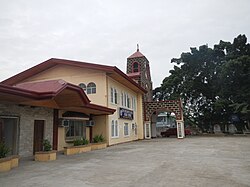 St. Bartholomew the Apostle Church
 Public market
 Biggest gymnasium in Nueva Ecija


