Sapporo Municipal Subway 9000 series
Japanese train type
From Wikipedia, the free encyclopedia
The Sapporo Municipal Subway 9000 series (札幌市交通局 9000形) is a DC electric multiple unit (EMU) rubber-tyred metro train type operated by Sapporo Municipal Subway on the Tōhō Line in the city of Sapporo, Japan, since 8 May 2015.[1]

| Sapporo Municipal Subway 9000 series | |
|---|---|
Set 9105 at Ōdōri in September 2016 | |
 Interior (January 2016) | |
| In service | 2015–present |
| Manufacturer | Kawasaki Heavy Industries |
| Built at | Kobe |
| Replaced | 7000 series |
| Constructed | 2014–2016 |
| Entered service | 8 May 2015 |
| Number built | 80 vehicles (20 sets) |
| Number in service | 80 vehicles (20 sets) |
| Formation | 4 cars per trainset |
| Fleet numbers | 9101–9120 |
| Operator |  Sapporo Municipal Subway Sapporo Municipal Subway |
| Line served |  Tōhō Line Tōhō Line |
| Specifications | |
| Car body construction | Aluminium |
| Train length | 69,250 mm (227 ft 2 in) |
| Car length | 17,425 mm (57 ft 2 in) (end cars) 17,200 mm (56 ft 5 in) (intermediate cars) |
| Width | 3,080 mm (10 ft 1 in) |
| Height | 3,910 mm (12 ft 10 in) |
| Floor height | 1,300 mm (4 ft 3 in) |
| Doors | 3 pairs per side |
| Maximum speed | 70 km/h (43 mph) |
| Traction system | IGBT–VVVF |
| Traction motors | 3-phase AC induction motor |
| Acceleration | 3.5 km/(h⋅s) (2.2 mph/s) |
| Deceleration | 4.0 km/(h⋅s) (2.5 mph/s) (service) 4.8 km/(h⋅s) (3.0 mph/s) (emergency) |
| Electric systems | 1,500 V DC overhead catenary |
| Current collection | Pantograph |
| UIC classification | 2'2'+Bo'Bo'+Bo'Bo'+2'2' |
| Safety systems | ATC and ATO |
| Track gauge | Central guideway with rubber tires |
Design
The trains are built by Kawasaki Heavy Industries in Kobe and have aluminium bodies.[2]
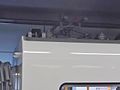 A single-arm pantograph on car 9201, May 2015

Formations
The 9000 series trains are formed as four-car sets as shown below, consisting of two motored intermediate cars and two non-powered driving trailer cars.[3][4] The Tc1 car is at the Sakaemachi end.[3]
| Car No. | 1 | 2 | 3 | 4 |
|---|---|---|---|---|
| Designation | Tc1 | M1 | M2 | Tc2 |
| Numbering | 9100 | 9200 | 9300 | 9800 |
| Weight (t) | 25.1 | 27.8 | 27.7 | 25.3 |
| Capacity (total/seated) | 121/40 | 137/48 | 137/48 | 121/40 |
The two intermediate motor cars each have one single-arm pantograph.[3]
Interior
Passenger accommodation consists of longitudinal bench seating, with a wheelchair space in each car.[3]
 Priority seating and wheelchair space at the end of a car in January 2016
 LCD passenger information displays above the doorways, May 2015


History
The order for the fleet of new trains was placed with Kawasaki Heavy Industries in April 2013 at a cost of approximately 12 billion yen (excluding bogies and other equipment ordered separately),[5] and the first trainset was unveiled to the media in November 2014.[2] It entered revenue service on 8 May 2015.[1]
