Sarnath capital
From Wikipedia, the free encyclopedia
| Sarnath capital (3rd-1st century BCE) | |
|---|---|
 .jpg) The Sarnath capital front (actual view) and back (reconstructed from available photographs). | |
| Material | Stone |
| Created | 3rd-1st century BCE |
| Present location | Sarnath Museum, India |
  Sarnath | |
The Sarnath capital is a pillar capital, sometimes also described as a "stone bracket", discovered in the archaeological excavations at the ancient Buddhist site of Sarnath in 1905.[1] The pillar displays Ionic volutes and palmettes.[2][3] It used to be dated to the 3rd century BCE, during the Mauryan Empire period,[4][1] but is now dated to the 1st century BCE, during the Sunga Empire period.[2]
One of the faces shows a galloping horse carrying a rider, while the other face shows an elephant and its mahaut.[2]
The capital is suggestive of the Hellenistic Ionic order, and is often discussed in conjunction with the Pataliputra capital.[5][6] The two capitals have also been described as "quasi-Ionic", and compared for example to the anta capitals of the Temple of Apollo in Didyma.[7]
The capital is now located in the Sarnath Museum.[2]
 Reconstruction of the full capital by Percy Brown
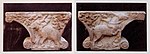 Frontal views of the Sarnath capital, in the Sarnath Museum


