Scanning joule expansion microscopy
From Wikipedia, the free encyclopedia
In microscopy, scanning joule expansion microscopy (SJEM) is a form of scanning probe microscopy heavily based on atomic force microscopy (AFM) that maps the temperature distribution along a surface. Resolutions down to 10 nm have been achieved[1] and 1 nm resolution is theoretically possible. Thermal measurements at the nanometer scale are of both academic and industrial interest, particularly in regards to nanomaterials and modern integrated circuits.

Scanning joule expansion microscopy is based on the contact operation model of atomic force microscopy. During the operation, the tip on the cantilever is brought into contact with the surface of the sample. AC or pulsed electrical signal is applied to the sample creating Joule heating and resulting in periodic thermal expansion.[2] At the same time, the laser, which is focused on the top surface of the cantilever and the photodiode of the equipment, detects the displacement of the cantilever. The detecting photodiode is composed of two segments, which normalizes the incoming signal deflected from the cantilever. This differential signal is proportional to the cantilever deflection.[3]
The deflection signals are caused not only by sample topography, but also by the thermal expansion caused by Joule heating. Since AFM has feedback controller with a bandwidth, for example 20 kHz (different AFM may have different bandwidths), the signal below 20 kHz is captured and processed by the feedback controller which then adjusts the z-piezo to image surface topography. Joule heating frequency is kept well above 20 kHz to avoid feedback response and to separate topological and thermal effects. The upper limit of the frequency is limited by the decrease of thermoelastic expansion with the inverse power of the modulation frequency and the frequency characteristics of the cantilever arrangement.[4] A lock-in amplifier is specially tuned to the Joule heating frequency for detecting only the expansion signal and provides the information to an auxiliary Atomic Force Microscopy channel to create the thermal expansion image. Usually expansion signals approximately 0.1 Angstroms start to be detected, although the resolution of SJEM highly depends on the whole system (cantilever, sample surface, etc.).
By comparison, Scanning Thermal Microscopy (SThM) has coaxial thermocouple at the end of sharp metal tip. The spatial resolution of SThM critically depends on the thermocouple sensor size. Much effort has been dedicated to reducing sensor size to sub-micrometre scales. The quality and resolution of the images are very dependent on the nature of the thermal contact between tip and the sample; hence it is quite difficult to control in a reproducible way. The fabrication also becomes very challenging particularly for thermocouple sensor size below 500 nm.[2] With optimization on the design and the fabrication, it was possible to achieve resolution around 25 nm.[3] Scanning Joule Expansion Microscopy, however, has the potential of achieving similar to AFM resolution of 1~10 nm. In practice, however, the spatial resolution is limited to the size of the liquid film bridge between the tip and the sample, which is typically about 20 nm.[2] The microfabricated thermocouples used for Scanning Thermal Microscopy are rather expensive and more importantly very fragile. Scanning Joule Expansion Microscopy has been used to measure the local heat dissipation of an in-plane gate (IPG) transistor to study hot spots in semiconductor devices,[4] and thin-film alloy like cobalt-nickel silicide.[5]
Signal acquisition and analysis
Signal obtained by the AFM (and captured by lock-in amplifier) are actually representations of the cantilever deflection at a specific frequency. However, besides thermal expansion, several other sources may also result in cantilever deflection.
Thermally induced cantilever bending
This is usually due to the mismatch in thermal expansion of two cantilever materials, for instance, silicon cantilever coated with a thin layer of metal (to increase the deflection). When heated, materials with higher expansion coefficient will expand more than the material with lower expansion coefficient. In this case, two materials, one in tensile strain, the other in compression strain, will induce substantial bending. However, this mechanism can be excluded for two reasons; first, cantilever coatings have been stripped experimentally and no change in signal was observed; second, the calculated thermal diffusion length in SiNx and Si cantilevers at the SJEM working frequency (typically 10 kHz~100 kHz) is small, much smaller than the length of the cantilever (typically 100 um).[2][6]
Pressure waves
When the sample heats and contracts due to rapid Joule heating from an applied AC power source, pressure waves may be radiated from the sample. This wave may interact with the cantilever, causing additional deflection. However, this possibility is unlikely. For sinusoidal heating, the wavelength of the acoustic wave in air with speed of 340 m/s is about several millimeters, which is much larger than the length of cantilever. Furthermore, experiments have been carried out under vacuum, in which case there are no air pressure waves. In the experiment, it was observed that when the cantilever was out of contact with sample surface, no deflection signal was detected.[2][6]
Piezoelectric effect
In piezoelectric materials, mechanical expansion occurs due to applied bias. Therefore, if the sample is such a material, an additional piezoelectric effect must be considered when analyzing the signal. Typically, piezoelectric expansion is linearly dependent on applied voltage and a simple subtraction can be used to correct for this effect.
Electrostatic force interaction
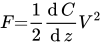
When a bias is applied to the sample for Joule heating, there is also an electrostatic force interaction between the tip and the sample. The tip-sample electrostatic force can be represented as , in which C is the tip sample capacitance, and V is the voltage, Z is the tip and sample distance. This force also depends on , the same as the expansion signal. Usually electrostatic force is small because the sample has been covered with a polymer layer. However, when applied voltage is large, this force needs to be considered. Electrostatic force does not depend on the frequency of the applied AC signal, therefore allowing for a simple method to differentiate and account for this contribution.[2][6]

Thermal expansion
This is primary mode of signal and the main goal of SJEM. The substrate expands when Joule heated, resulting in change in the measured profile by the cantilever, resulting in a change in signal. However, thermal expansion coefficients can vary significantly. For example, the thermal expansion coefficients of metal are typically one order of magnitude higher than those of dielectric and amorphous materials; while the expansion coefficient of polymer is one order higher than those of metals. So by coating the sample surface with a layer of polymer, the expansion signal could be enhanced. More importantly, after coating, the signal only depends on the temperature, independent of the expansion coefficient of different materials, allowing for SJEM to be used for a wide array of samples. Expansion signal increases linearly with temperature and thus quadratically with voltage. In addition, expansion signal increases monotonically with the thickness of coating polymer, while the resolution will decrease due to greater thermal diffusion. Lastly, expansion signal decreases as the frequency increases.
Extraction of Temperature
By using the expansion signal, the temperature can be extracted as follows: the signal that captured by the lock-in amplifier is converted into the bending of cantilever. Using , and applying the known expansion coefficient, and polymer thickness, (which could be measured by AFM or ellipsometer), the expansion signal is obtained. The smallest expansion that can be resolved is about 10pm. In order to extract accurate temperatures, additional modeling taking into account thermal expansion and cantilever bending is necessary. Moreover, calibration using a reference system, such as metallic films, is required.


Modeling
One-dimensional transient finite element model
When the sample is large enough, edge effects can be ignored. Therefore, a simple one-dimensional finite element model can be a good approximation.
The basic thermal equation is:
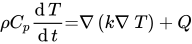
Here, ρCp is the heat capacitance;K is the thermal conductivity and Q is the input power.
Rearrange the equation in a discrete form according to each element:

Here, represents the specific temperature of position element n at time element t. Using software could solve the equations and obtained the temperature T. The expansion magnitude could be obtained by:

is the thermal expansion coefficient of the polymer and L is its thickness.
Two- or three-dimensional finite element model with electrical-thermal-mechanical coupling
Commercialized software can be used for 2D/3D finite element modeling. In such software, the appropriate differential equations for electrical, thermal and mechanical expansion are chosen and proper boundary conditions are set. In addition, electrical-thermal coupling exists in the sample because the resistance is a function of temperature. This is additionally accounted for by typical FEM software packages.
