Schamel equation
From Wikipedia, the free encyclopedia
The Schamel equation (S-equation) is a nonlinear partial differential equation of first order in time and third order in space. Similar to a Korteweg–De Vries equation (KdV),[1] it describes the development of a localized, coherent wave structure that propagates in a nonlinear dispersive medium. It was first derived in 1973 by Hans Schamel [2] to describe the effects of electron trapping in the trough of the potential of a solitary electrostatic wave structure travelling with ion acoustic speed in a two-component plasma. It now applies to various localized pulse dynamics such as:
The Schamel equation is [2]

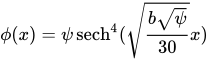
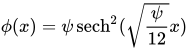
where stands for . In the case of ion-acoustic solitary waves, the parameter reflects the effect of electrons trapped in the trough of the electrostatic potential . It is given by , where , the trapping parameter, reflects the status of the trapped electrons, representing a flat-topped stationary trapped electron distribution, a dip or depression. It holds , where is the wave amplitude. All quantities are normalized: the potential energy by electron thermal energy, the velocity by ion sound speed, time by inverse ion plasma frequency and space by electron Debye length. Note that for a KdV equation is replaced by such that the nonlinearity becomes bilinear (see later).





Solitary wave solution

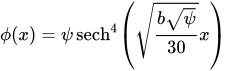


Proof by pseudo-potential method
The proof of this solution uses the analogy to classical mechanics via
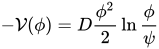
with , being the corresponding pseudo-potential. From this we get by an integration: , which represents the pseudo-energy, and from the Schamel equation:
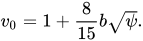
. Through the obvious demand, namely that at potential maximum, , the slope of vanishes we get: . This is a nonlinear dispersion relation (NDR) because it determines the phase velocity given by the second expression. The canonical form of is obtained by replacing with the NDR. It becomes:
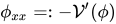

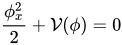




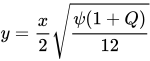
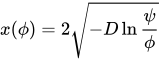
The use of this expression in , which follows from the pseudo-energy law, yields by integration:
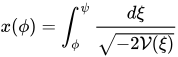
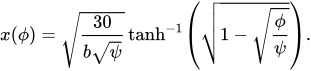
This is the inverse function of as given in the first equation. Note that the integral in the denominator of exists and can be expressed by known mathematical functions. Hence is a mathematically disclosed function. However, the structure often remains mathematically undisclosed, i.e. it cannot be expressed by known functions (see for instance Sect. Logarithmic Schamel equation). This generally happens if more than one trapping scenarios are involved, as e.g. in driven intermittent plasma turbulence.[8]





![{\displaystyle \phi (x)=\psi \operatorname {sech} ^{4}(y)\left[1+{\frac {1}{1+Q}}\tanh ^{2}(y)\right]^{-2}}](https://wikimedia.org/api/rest_v1/media/math/render/svg/1463ce30556f7699a5f3b64094eb2ce52b0db880)