Schatten norm
From Wikipedia, the free encyclopedia
In mathematics, specifically functional analysis, the Schatten norm (or Schatten–von-Neumann norm) arises as a generalization of p-integrability similar to the trace class norm and the Hilbert–Schmidt norm.
Special cases
Let , be Hilbert spaces, and a (linear) bounded operator from to . For , define the Schatten p-norm of as


![{\displaystyle \|T\|_{p}=[\operatorname {Tr} (|T|^{p})]^{1/p},}](https://wikimedia.org/api/rest_v1/media/math/render/svg/4cda85cbc741f7fdf34db91aa5f7c23f080cd097)
where , using the operator square root.
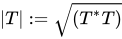
If is compact and are separable, then

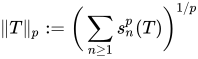
for the singular values of , i.e. the eigenvalues of the Hermitian operator .

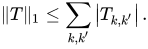
- The Schatten 1-norm is the nuclear norm (also known as the trace norm, or the Ky Fan n-norm[1]).
- The Schatten 2-norm is the Frobenius norm.
- The Schatten ∞-norm is the spectral norm (also known as the operator norm, or the largest singular value).
Properties
In the following we formally extend the range of to with the convention that is the operator norm. The dual index to is then .

![{\displaystyle [1,\infty ]}](https://wikimedia.org/api/rest_v1/media/math/render/svg/4470d735d311a79593637581b651c6611af107d3)


- The Schatten norms are unitarily invariant: for unitary operators and and ,


![{\displaystyle p\in [1,\infty ]}](https://wikimedia.org/api/rest_v1/media/math/render/svg/97b602ff0617b1b60e63d22200cad684dc5b26a0)

- They satisfy Hölder's inequality: for all and such that , and operators defined between Hilbert spaces and respectively,






If satisfy , then we have
![{\displaystyle p,q,r\in [1,\infty ]}](https://wikimedia.org/api/rest_v1/media/math/render/svg/7e9c5154a292d43211a6148a4dcb00afe151889e)

- .

The latter version of Hölder's inequality is proven in higher generality (for noncommutative spaces instead of Schatten-p classes) in.[2] (For matrices the latter result is found in[3].)

- Sub-multiplicativity: For all and operators defined between Hilbert spaces and respectively,

- Monotonicity: For ,


- Duality: Let be finite-dimensional Hilbert spaces, and such that , then


- where denotes the Hilbert–Schmidt inner product.

- Let be two orthonormal basis of the Hilbert spaces , then for