Schoenus albovaginatus
From Wikipedia, the free encyclopedia
| Schoenus albovaginatus | |
|---|---|
 | |
| Whitesheath Veldrush | |
Scientific classification  | |
| Kingdom: | Plantae |
| Clade: | Tracheophytes |
| Clade: | Angiosperms |
| Clade: | Monocots |
| Clade: | Commelinids |
| Order: | Poales |
| Family: | Cyperaceae |
| Genus: | Schoenus |
| Species: | S. albovaginatus |
| Binomial name | |
| Schoenus albovaginatus T.L.Elliott & Muasya | |
 | |
| Documented collection localities in South Africa | |
| Synonyms[1] | |
| |
Schoenus albovaginatus is a species of sedge endemic to the mountains of south-western South Africa.
The key diagnostic character of S. albovaginatus is its ivory-colored, membranaceous leaf sheaths.[1] The inflorescence of S. albovaginatus is short and congested, appearing compressed between its lower primary inflorescence bracts.[1] Another key morphological character of S. albovaginatus are its relatively long and numerous perianth bristles.[1]
Similar to S. albovaginatus, Schoenus aureus and Schoenus triticoides also have ivory-colored, membranaceous, loose leaf sheaths; however, the inflorescence shapes of the latter two species differ from that of S. albovaginatus.[1] The lower inflorescence bracts of S. albovaginatus do not have the marginal membranaceous extensions that are evident in S. aureus and S. triticoides.[1] In addition, the wheat-like panicle of S. triticoides is longer than the short, compressed inflorescence of S. albovaginatus.[1] Finally, neither S. aureus nor S. triticoides have the long perianth bristles that are present in the spikelets of S. albovaginatus.[1]
The flowering heads of S. albovaginatus resemble those of Schoenus pictus;[2] however, the latter species lacks the membranaceous leaf sheaths present in S. albovaginatus.
Plants in the southern African Schoenus clade are very difficult to identify, which is similar to other sedges. It appears that part of this problem is caused by the tendency of the southern African Schoenus to form hybrids with each other.[3] It is not clear whether S. albovaginatus forms hybrids with other southern African Schoenus species.[1]
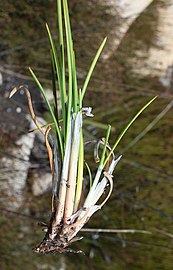 Membranaceous base of plant
 Flowering heads
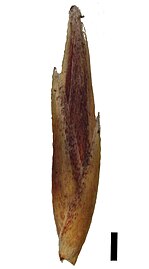 Spikelet (black scale bar represents 1 mm)
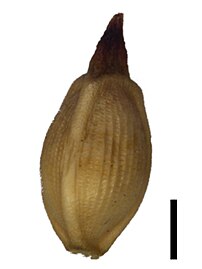 Nutlet (black scale bar represents 1 mm)


