Schoenus crinitus
From Wikipedia, the free encyclopedia
| Schoenus crinitus | |
|---|---|
 | |
| Downy veldrush | |
Scientific classification  | |
| Kingdom: | Plantae |
| Clade: | Tracheophytes |
| Clade: | Angiosperms |
| Clade: | Monocots |
| Clade: | Commelinids |
| Order: | Poales |
| Family: | Cyperaceae |
| Genus: | Schoenus |
| Species: | S. crinitus |
| Binomial name | |
| Schoenus crinitus T.L.Elliott & Muasya | |
 | |
| Documented collection localities in South Africa | |
Schoenus crinitus is a species of sedge endemic to the Worcester region of the Western Cape Province of South Africa.[1]
Similar to Schoenus adnatus, Schoenus gracillimus and Schoenus schonlandii, the inflorescence of S. crinitus has few, dispersed spikelets.[1] The spikelets of S. crinitus are not pendulous (hanging), such as often occurs in S. gracillimus.[1]
Schoenus crinitus is a more hairy and rigid species compared to S. adnatus and S. gracillimus.[1] As opposed to S. adnatus, S. crinitus does not have spikelet receptacles that are adnate to the basal glume (bract).[1]
Schoenus lucidus and Schoenus neovillosus also have hairy spikelets and culms (flowering stems), but the spikes of these two species are appressed between the two major bracts of the inflorescence.[1] In contrast, the inflorescence bracts of S. crinitus are relatively narrow and the inflorescences display more lateral branching.[1] Another major difference is that the culms of S. crinitus have deeper ridges compared to the nearly round culms of S. lucidus and S. neovillosus.[1]
The tendency of southern African Schoenus to form hybrids with each other might partially explain some of the difficulties in identifying them.[1][2] Recent research shows that S. crinitus is likely diploid and not of recent polyploid origin.[3]
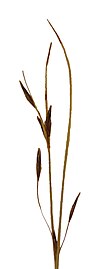 Flowering head (inflorescence)
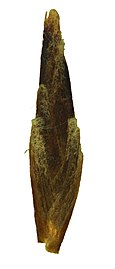 Spikelet
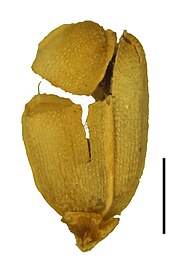 Broken nutlet (the black scale bar represents 1 mm)


